

Traqer emerged from a problem we ran into at Grow and Convert, our content marketing agency. When clients started asking how to measure their visibility in AI search, we went looking for tools.
We tested several, and ran into two problems we couldn't get past: the pricing was outlandishly high for an agency tracking multiple brands, and the data didn't match what we were seeing when we used the platforms ourselves.
Why other AI visibility tracking tools didn’t make sense
First, we ran into a straightforward pricing problem. Most AI visibility tools charge on a per-brand basis. For an agency with dozens of clients, that model becomes prohibitively expensive. We were looking at costs running into the thousands of dollars per month just to track a handful of brands across a handful of models. That ruled out most of the tools available (before we even got into the data quality question).
But the other issue was the way that these tools measured visibility.
When someone uses ChatGPT, Perplexity, or any other LLM, the question they type is rarely the full picture of what the model is working with. LLMs draw on months or years of prior conversation history, saved context, and user preferences to shape their responses. A question that reads as six words on screen might effectively be carrying pages of additional context that the model already knows about the user.
We wrote about this in detail in our piece on Invisible Prompts. The clearest example: one of Grow and Convert’s clients asked ChatGPT for the best SEO companies. Her literal prompt was casual and brief. But ChatGPT already knew her industry, her company size, her constraints, and her goals from prior conversations, and it recommended our agency based on all of that invisible context. When Devesh (our co-founder) asked the same question from his own account, the answer was completely different.
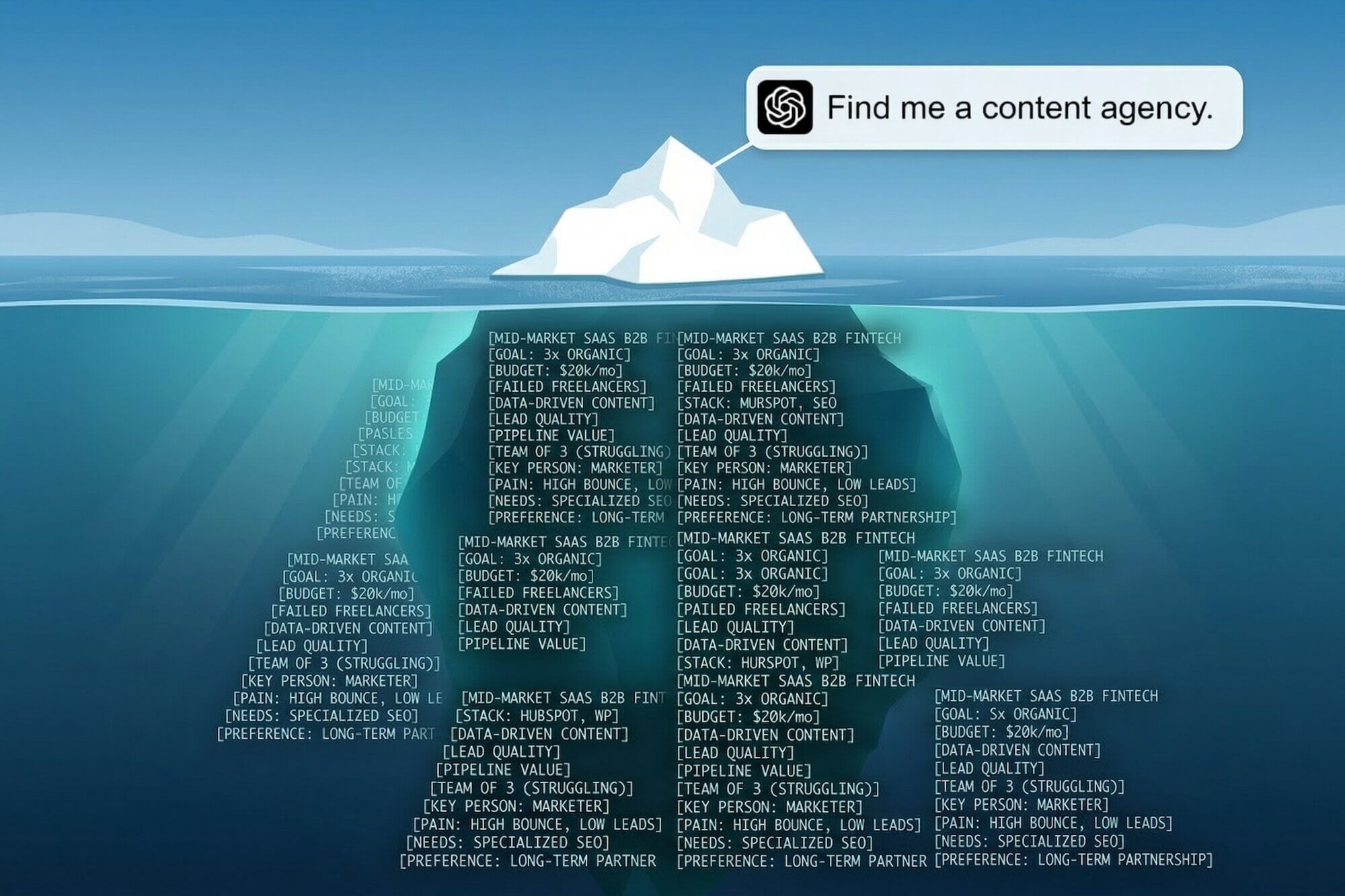
This isn't the same as LLMs producing non-stable outputs, though that's also true (i.e., the instability of LLM outputs means the same user asking the same question again will get a slightly different response). The invisible prompts issue is separate: it means that two different users asking what looks like the same question are, in practice, asking meaningfully different things. The effective prompt includes everything the model knows about you that you didn't explicitly type.
The implication for AI visibility tracking is significant. No tool can replicate a real user's invisible context, so tracking single prompts doesn’t make sense. What any tool can do is run queries in a neutral, logged-out session with no prior history, which gives you a consistent baseline. But that baseline will never match what any individual user actually sees, and a single-prompt result from a single run tells you very little on its own.
Given all of this, we spent time working through what a useful measurement framework would actually look like. The approach we settled on is topic-based tracking.
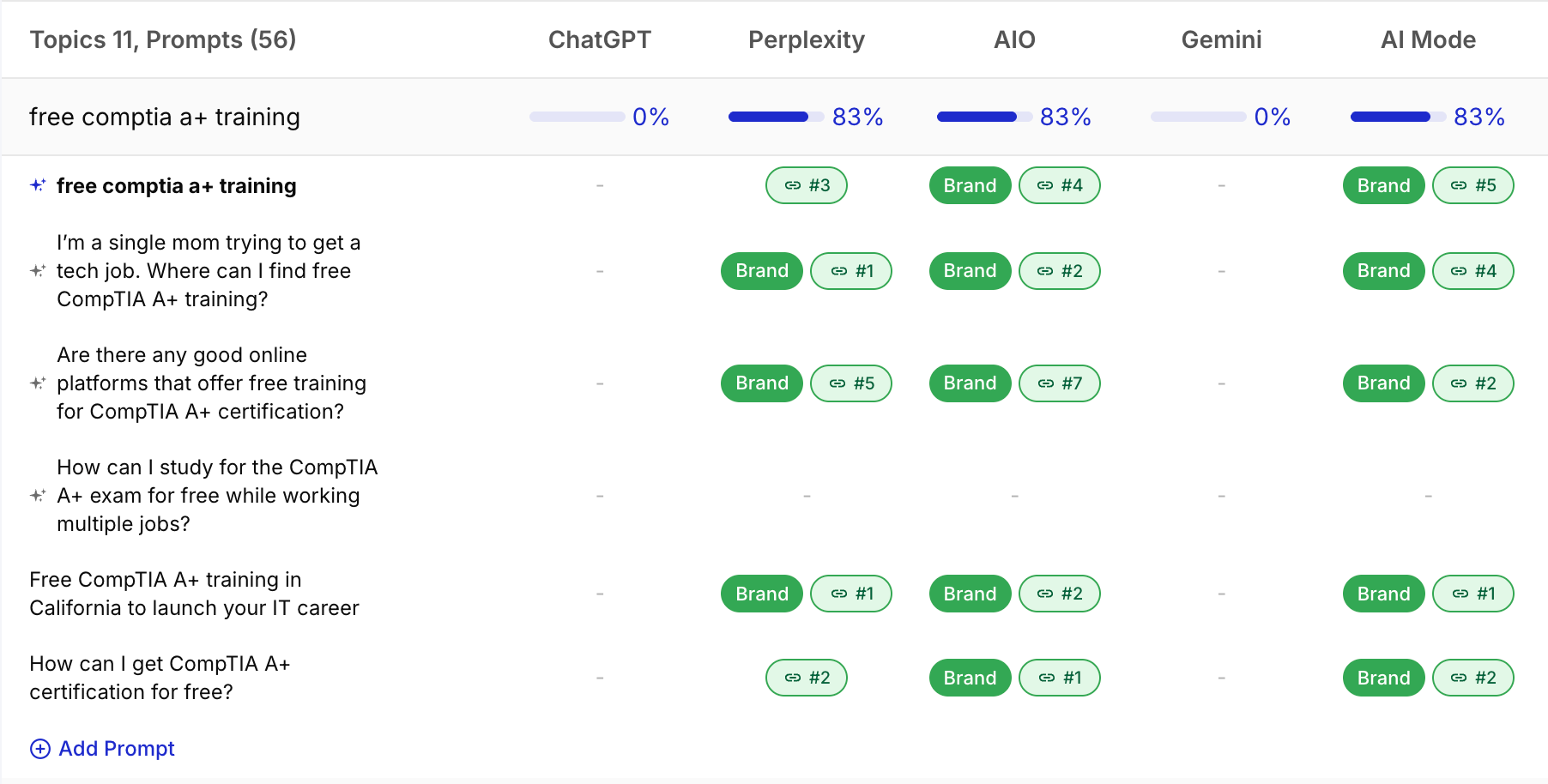
A topic is a buying-intent area: something like “accounting software for small businesses,” “legal services for waste disposal companies,” or “healthy dog food brands.”
Within each topic, Traqer runs multiple prompt variations that approach it from different angles. Rather than asking whether you appeared for a single prompt, the question becomes: across all the ways someone might ask about this topic, how often does your brand show up, and on which models?
That gives you something you can act on. "We show up in 60% of prompts on Perplexity for this topic and 20% on ChatGPT" is a directional signal you can connect to content decisions. A single-prompt result doesn't give you that. We've written more about this in our piece on Topic-Based GEO.
Why single visibility percentages create problems
Alongside single-prompt tracking, we noticed that most tools use a single brand-level visibility percentage as the primary metric. It’s displayed prominently at the top of your brand page, usually with a graph showing its changes over time. The issue is structural: optimizing toward that number creates bad incentives. If your team starts tracking new, ambitious topics where you have low visibility, the overall percentage drops. It looks like performance declined, but nothing changed about your real-world visibility.
That discourages the kind of ambitious tracking that helps you identify where to improve, and it becomes a reporting problem if you're presenting results to senior stakeholders who don't know to account for it.
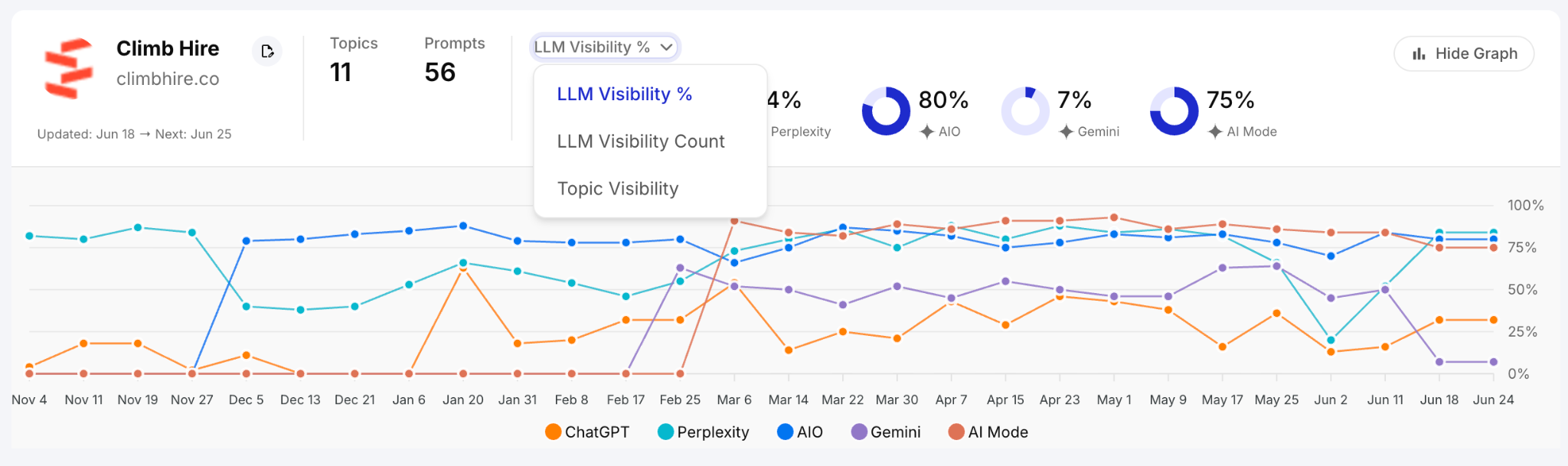
Traqer uses three visibility models instead of one:
LLM Visibility % shows your percentage of appearances per LLM, which can drop when you add new topics.
LLM Visibility Count shows the raw number of prompts you appear in, which only goes up as your visibility improves.
Topic Visibility groups your topics into high, medium, and low buckets so you can see at a glance where you're strong and where you have gaps. The last two can't be moved by adding or removing prompts.
You can read more about this in our piece on AI visibility tracking tools for agencies.
Brand mentions versus citations
Another issue with the tools we tested was that they were treating brand mentions and source citations as equivalent. They aren't. A brand mention is when your company is named in the recommendation: “for that use case, you might look at Xero.” A citation is when your URL appears as a source link the model used to construct its response. In practice, most users don't click citation links inside LLM responses. What registers is whether your brand is named.
If you're being cited but not mentioned, the issue is brand visibility: LLMs are drawing on your content but not recommending you. If you're being mentioned but not cited, the issue is content coverage: you have brand recognition but the models aren't drawing on your material.
Those are different problems that point to different content decisions, and a blended score hides which one you're dealing with. Traqer separates the two and lets you toggle between them.
An additional note on data accuracy
There is one more issue worth addressing: even web-scraped data from logged-out sessions is more accurate than API data, but for a different reason than you might expect.
LLM APIs expose the base model in a relatively raw state. The web interfaces most users interact with layer additional instructions on top: system prompts, interface tuning, model configurations that shape how responses are structured and what gets recommended. The same question asked through ChatGPT's website goes through a different process than the same question sent via API, and the outputs can differ substantially, including which brands get named.
Building on APIs is understandable from a product development perspective. It's faster and simpler to implement. Ravi, who leads development at Traqer, has noted that an API-based tool can be built in a week; the scraping infrastructure we ended up building took six to eight months of iteration. Traqer runs queries through real browser sessions, logged out, to capture what a user would actually see. But as noted above, even that has limits: no tool can replicate the invisible context a real user brings to a conversation.
Releasing Traqer to the world
Traqer was built for internal use at our first. Once we had something working well enough to use for our own clients, other people started asking for access: clients first, then other agencies.
The pricing reflects where it came from. Per-brand pricing is what made existing tools unworkable for us, so every plan includes unlimited brands and unlimited users, starting at just $25 per month. We're a bootstrapped agency, not a VC-funded startup, and the cost structure reflects that.
If you're running an agency tracking visibility for multiple clients, or a marketing team trying to understand how your brand appears across AI search platforms, you can get started at traqer.ai.