
Most marketing teams running an AI search strategy are working from a hypothesis rather than data. The hypothesis is reasonable: rank well in Google, and you'll appear in AI-generated answers. But reasonable isn't the same as verified. Without visibility at the topic level and across individual LLMs, it stays a hypothesis.
That was the situation for Constitution Lending, a Connecticut-based private money lender, when Grow and Convert started tracking their AI visibility with Traqer. The content strategy was built on a clear hypothesis: strong bottom-of-funnel SEO rankings would lead to better AI visibility, because LLMs search the web when answering buying-intent questions. If Constitution Lending ranked on Google for "best DSCR lenders in Connecticut," it would improve its chances of appearing when someone asked ChatGPT or Perplexity the same thing.
But the hypothesis needed verification. Traqer provided it: by topic, by LLM, and with the brand mention and citation data separated. This is what the data showed, and what it clarified about where to focus next.
(For background on the content strategy that produced these rankings, see the full Constitution Lending case study on the Grow and Convert blog.)
The measurement problem: why a single prompt doesn't tell you much
Before covering what Traqer found, it's worth explaining why AI visibility demands a different approach to measurement.
The core issue is that AI-generated responses are personalized in a way that makes individual prompt results almost impossible to interpret reliably. When someone opens ChatGPT and asks about the best private money lenders in Connecticut, the response they get is shaped by their entire conversation history, the context ChatGPT has built up about them over time, and factors they haven't explicitly stated in that session. Someone who has been researching real estate investment for six months will get a different answer than someone asking for the first time.
This is what Grow and Convert calls Invisible Prompts: the personalization happening inside LLMs that makes it impossible to reproduce a real user's experience; even with the exact same query.
The second issue is that even setting aside personalization, LLM responses vary from run to run for the same prompt. Research from Rand Fishkin at SparkToro found that Claude would need to be asked the same question 1,429 times before producing two answers with the same brands in the same order.
The practical conclusion from both of these points is that tracking a single prompt tells you very little.
What you can measure, and what gives you a signal worth acting on, is how likely a brand is to be mentioned across a range of different prompt variations for the same topic, tracked consistently over time. That's topic-based visibility, and it's what Traqer is built around.
For a topic like "DSCR lenders," Traqer tracks a cluster of prompts approaching the subject from different angles, runs them across ChatGPT, Perplexity, Google AI Overviews, Gemini, and Claude, and produces a visibility percentage per LLM. Traqer also separates brand mentions from citations, because they are not equivalent.
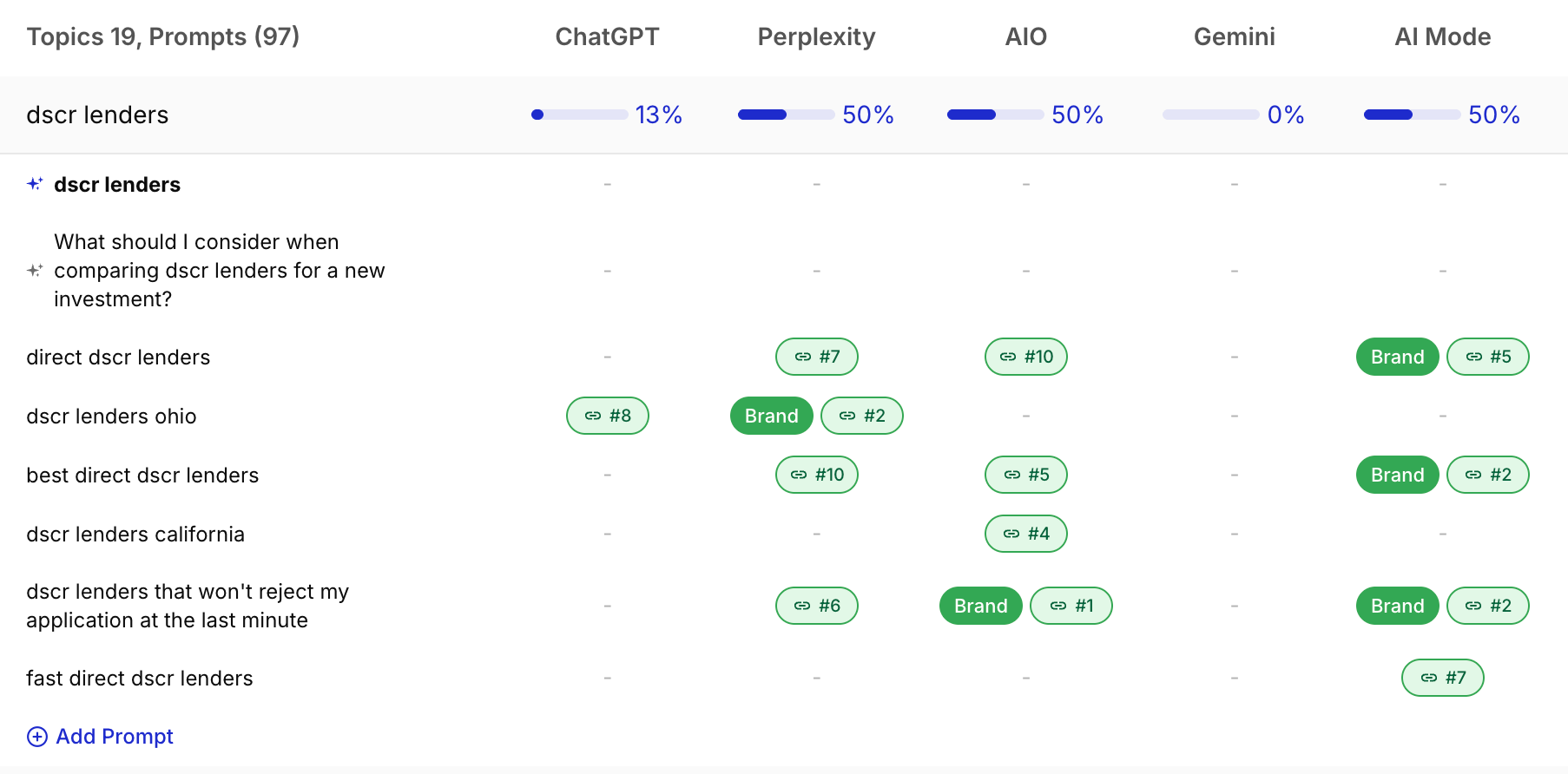
A brand mention is when an LLM names the brand in its recommendation. A citation is when the brand's URL appears as a source link. Most tools combine them into a single score; Traqer keeps them separate, so it's clear whether a brand is being recommended or just referenced.
(For more on this, see Traqer's post on AI visibility tracking tools for agencies.)
What Traqer showed about Constitution Lending
Constitution Lending's business covers four areas: lending, investing, cash-for-houses, and non-performing loans. Each area maps to a set of topics in Traqer, with multiple prompts per topic.
Lending: the hypothesis confirmed
The lending side had the longest content history. Differentiated articles targeting keywords like "best LLC mortgage lenders," "best DSCR lenders in Connecticut," and "DSCR lenders for multifamily homes" had reached page one on Google. Traqer confirmed the expected pattern.
For the topics where Constitution Lending had strong SEO rankings, it was showing up consistently as a top-three recommendation across Perplexity and Google AIO. For the "LLC mortgage lenders" topic, Constitution Lending appeared across multiple prompt variations in both Perplexity and AIO.
This confirmed the core assumption: when LLMs search the web to answer buying-intent queries, they draw on pages that already rank in traditional search. The content strategy and the AI visibility were working from the same foundation.
But the per-LLM breakdown also revealed an important gap.
The ChatGPT gap
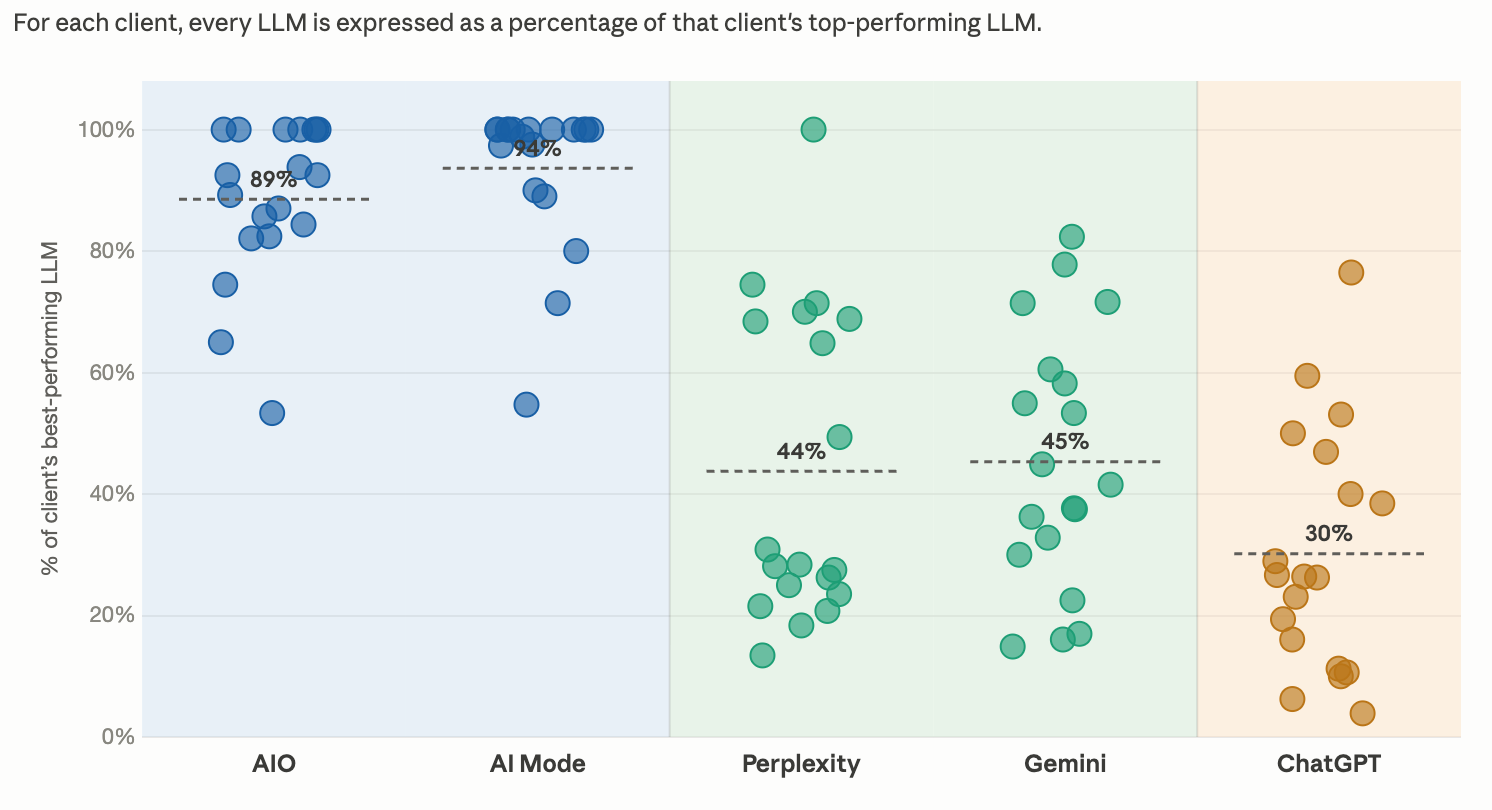
Constitution Lending's visibility on ChatGPT was noticeably lower than on Perplexity and Google AIO. Perplexity and AIO behave more like search summarisers: brands with strong SEO rankings tend to have strong visibility there. ChatGPT weighs its training data more heavily and appears to place greater importance on a brand being mentioned across multiple third-party sources, not just on its own site.
The content strategy had focused primarily on owned content. That was sufficient for Perplexity and AIO, but not for ChatGPT. The implication is that external brand mentions (appearances in roundup articles, industry comparison posts, and content on sites LLMs already cite) matter more for ChatGPT than for search-based LLMs.
A blended visibility score across all LLMs would have hidden this. The aggregate number would have looked reasonable. The per-LLM breakdown made the gap visible, and pointed toward a specific action.
Where Constitution Lending wasn't appearing
The most instructive data was about the topics where Constitution Lending wasn't visible.
Constitution Lending recently expanded into cash-for-houses. Content production in this area had started, but some articles hadn't yet ranked. When Traqer was checked for prompts like "sell my house fast Connecticut," Constitution Lending rarely appeared.
This is consistent with the pattern observed across clients: when a brand doesn't rank for a keyword in traditional search, it tends not to appear in AI-generated answers for related prompts either. The AI visibility gap reflects the SEO gap. Without tracking data, the temptation is to assume LLMs will surface a brand through other means: training data, domain authority, on-site signals. The correlation with search rankings is strong enough that content which hasn't yet ranked shouldn't be expected to drive AI visibility.
The non-performing loan fund area showed a similar picture. Competition there includes large established firms with decades of authority. Content production had begun, but early-stage results were expected.
Traqer confirmed that visibility was still limited, with Constitution Lending appearing for a small number of prompts but not yet consistently. That's useful context: it sets realistic expectations and confirms the content investment needs to continue.
What topic-based tracking makes possible
Before Traqer, the most practical way to check AI visibility was manual spot-checking: open ChatGPT, type the prompt being targeted with SEO, see if the brand appeared. This has two problems. Results aren't reproducible. And one prompt phrasing tells you very little about visibility across the range of ways a user might actually ask the same question.
Traqer's topic structure replaced that with something trackable over time. For each topic, a cluster of prompts is defined covering different phrasings and angles. Traqer runs them weekly and aggregates the results, making it possible to see whether visibility is improving as content matures and rankings shift. A single snapshot doesn't show trajectory. Visibility tracked over weeks and months does.
Traqer's Brand Mention Probability feature helps determine which prompts are worth tracking. Not all prompts generate brand recommendations. An informational question like "what is a DSCR loan" will produce an explanation without naming any lender, because there's no buying intent. Tracking those prompts alongside buying-intent prompts inflates the prompt count without adding actionable signal.
Traqer flags each prompt as high, medium, or low probability for brand mentions, which helps build topic sets focused on where AI visibility actually matters: at the bottom of the funnel, where users are evaluating specific products or services. (See Traqer's AI visibility tool overview for more on prompt selection.)
The next steps: what the data clarified
The Traqer data pointed to three priorities for Constitution Lending.
The first is continuing to publish owned content for topics where visibility is low. The correlation between SEO rankings and AI visibility holds consistently enough across clients that content remains the foundational lever. For the cash-for-houses and non-performing loan areas, the content investment needs time to compound before visibility follows.
The second is citation outreach, to address the ChatGPT gap specifically. Traqer's Analyze view shows which domains LLMs cite most frequently for a given topic, and which specific articles appear as sources repeatedly. That list becomes a targeting framework: if a roundup article on a frequently-cited domain doesn't mention Constitution Lending, getting included is a direct path to improving ChatGPT visibility. That outreach hasn't begun yet, but Traqer has already identified the relevant targets.
The third is the substance of owned content. When ChatGPT does recommend Constitution Lending, it tends to use language that closely mirrors what appears in the relevant article. The content on a brand's site directly shapes how LLMs describe that brand to users. If articles don't articulate specific differentiators (faster funding timelines, lower down payments, certainty of approval early in the process) an LLM won't have the material it needs to surface those advantages. Generic content produces generic recommendations.
Results to date
Across the four areas of the business, Traqer shows Constitution Lending appearing in the top three recommendations for over 50 bottom-of-funnel prompts across Perplexity and Google AIO. The lending side shows the strongest results: consistent top-three appearances for prompts around DSCR lenders, LLC mortgage lenders, fix-and-flip lenders, and private money lenders for residential real estate. The investor side shows similar strength for prompts around short-term real estate notes, high-yield real estate notes, and buying mortgage notes.
The cash-for-houses and non-performing loan areas are at an earlier stage. Traqer confirms visibility is building in both, and indicates where additional content investment will have the most impact.
ChatGPT visibility remains lower than Perplexity and AIO across most topics. That is expected to shift as citation outreach begins, and Traqer will give a clear read on whether it does.
To track AI search visibility across ChatGPT, Perplexity, Google AIO, Gemini, and Claude, Traqer offers a free trial. It shows which topics a brand is visible for, how visibility breaks down per LLM, and where the gaps are, at the level of detail that informs content decisions.