

There's a growing category of tools describing themselves as Perplexity rank trackers. The terminology is worth examining before you commit to one, because what they're measuring is not what "rank tracker" implies, and understanding the difference affects which tool you choose and how you interpret the data.
Perplexity doesn't have fixed rankings. Its answers are generated fresh for each query, vary based on phrasing, and are shaped by context no tool can see. What these trackers are actually measuring is brand visibility: how often your brand gets mentioned or cited when Perplexity generates answers about your category. That's a meaningful and trackable signal, but how reliably a tool measures it depends heavily on its methodology.
We built Traqer because we track AI visibility for clients at Grow and Convert and couldn't find a tool that measured it accurately at a price that worked for multi-brand tracking. Perplexity is one of five LLMs we cover. In our experience tracking it across dozens of clients, it behaves differently enough from other LLMs that those differences matter for how you set up tracking and what you do with the results. I'll get into what those differences are and why they matter below.
This article covers what to look for in a Perplexity tracker, how Perplexity behaves relative to other LLMs, and how the main tools compare.
What to look for in a Perplexity rank tracker
1. Topic-based tracking, not single-prompt tracking
The most important thing to check is whether the tool organizes tracking around topics or individual prompts. A topic is a buying-intent area, like "best logistics software for small fleets" or "B2B content marketing agencies." Within each topic, a good tool runs multiple prompt variations approaching the subject from different angles and reports your average visibility across them.
Perplexity doesn't return the same answer twice. Run the same query at different times and you'll get different citations, different phrasing, sometimes a different set of brands altogether. That variability is a problem for single-prompt tracking: if your brand appeared in 7 out of 10 runs of one prompt, you don't know whether that reflects genuine visibility or just how Perplexity happened to answer that day. Tracking multiple prompt variations across the same topic gives you an average that's less sensitive to that noise.
There's a deeper reason this matters. When a real user asks Perplexity a question, the answer they get is shaped by context the tracking tool can't see: their search history, prior conversations, memory settings, and details they've shared in that session. Perplexity is more constrained than ChatGPT or Gemini because it has to answer from retrieved content. But personalization still shapes what gets retrieved, how sources are weighted, and how the answer is phrased
We call this the Invisible Prompts problem. A single-prompt result tells you something about Perplexity's behavior in a neutral, context-free setting, not what a real user in your target market sees. Topic-based tracking is the best response to that limitation.
2. Real web interface data, not API data
Most tools pull their data from the Perplexity API rather than the actual Perplexity web product. Perplexity's own documentation acknowledges that the underlying model may differ between the API and the web interface for a given query, and the API exposes configurable parameters, including model selection, search context size, and domain filters, that tools may not set to match what the web interface actually uses. A brand appearing in an API response may not appear in what a real user sees in the product, and vice versa.
Traqer runs queries through real browser sessions, logged out, capturing what a user in Perplexity's web interface would actually see. It's technically more demanding to build, but the data reflects the real product rather than an API configuration that may not match it.
One important caveat: a logged-out, context-free session is still a simplified version of what a real user with months of conversation history sees. No tool can fully replicate personalized context. Real web scraping is the closest available neutral baseline.
3. Brand mentions separated from citations
This distinction probably matters for Perplexity more than for any other LLM. Perplexity cites sources heavily alongside its generated answers. A citation means your URL appeared as a source Perplexity drew from. A brand mention means Perplexity named your brand in the text of its answer.
They are not equivalent. Being cited as source 14 in a long list doesn't mean Perplexity is recommending you. Most tools count both as visibility, which produces numbers that look better than they are.
The practical consequence: across clients tracked in Traqer, Perplexity sits in a middle tier on combined brand mentions and citations. When you look at brand mentions only and separate out citations, Perplexity's numbers drop considerably (examples below). It performs closer to ChatGPT than to Google AI Overviews on actual recommendations. A tool that conflates the two will give you a misleadingly optimistic picture of how often Perplexity is actually recommending you to users.
4. Per-LLM visibility, not blended scores
If you're tracking AI visibility across platforms, make sure the tool shows Perplexity results separately rather than averaging them with ChatGPT, Gemini, and others. The variation across LLMs is where the useful signal is. A blended number hides it.
5. An affordable pricing structure
Some tools charge separately for each brand you track and each LLM you cover. If you're tracking one brand on Perplexity only, that's not an issue. If you're an agency tracking ten clients across five LLMs, you're multiplying those costs fifty times. It's worth checking the pricing model before you get there.
How Perplexity behaves differently from other LLMs
Before you look at your data, it's worth understanding where Perplexity sits relative to other platforms.
Perplexity is search-based, meaning it queries the web for every product-related prompt rather than drawing on training data the way ChatGPT does. That makes it more responsive to content and SEO than ChatGPT, but less so than Google's own AI products, because Perplexity searches its own index, not Google's. Across the brands we track in Traqer, Perplexity and Gemini both sit at roughly 40-50% of the visibility that Google AI Overviews and AI Mode produce. Strong Google rankings improve your chances in Perplexity, but don't guarantee it. Tracking Perplexity and AIO separately tells you whether your SEO work is reaching both, or just one.
We published the full data in our article on how the three tiers of AI search visibility differ across LLMs.
5 Perplexity rank tracking tools to consider
Traqer
Traqer is our tool, built because we manage SEO and content marketing for clients at Grow and Convert and couldn't find anything that measured AI visibility accurately or priced it in a way that worked for multi-client tracking.
Traqer covers Perplexity alongside ChatGPT, Google AI Overviews, Gemini, and Claude. Tracking is organized around topics rather than individual prompts. Each topic contains multiple prompt variations approaching the same buying-intent question from different angles, and visibility is reported as the percentage of those prompts where your brand appears, shown separately per LLM.
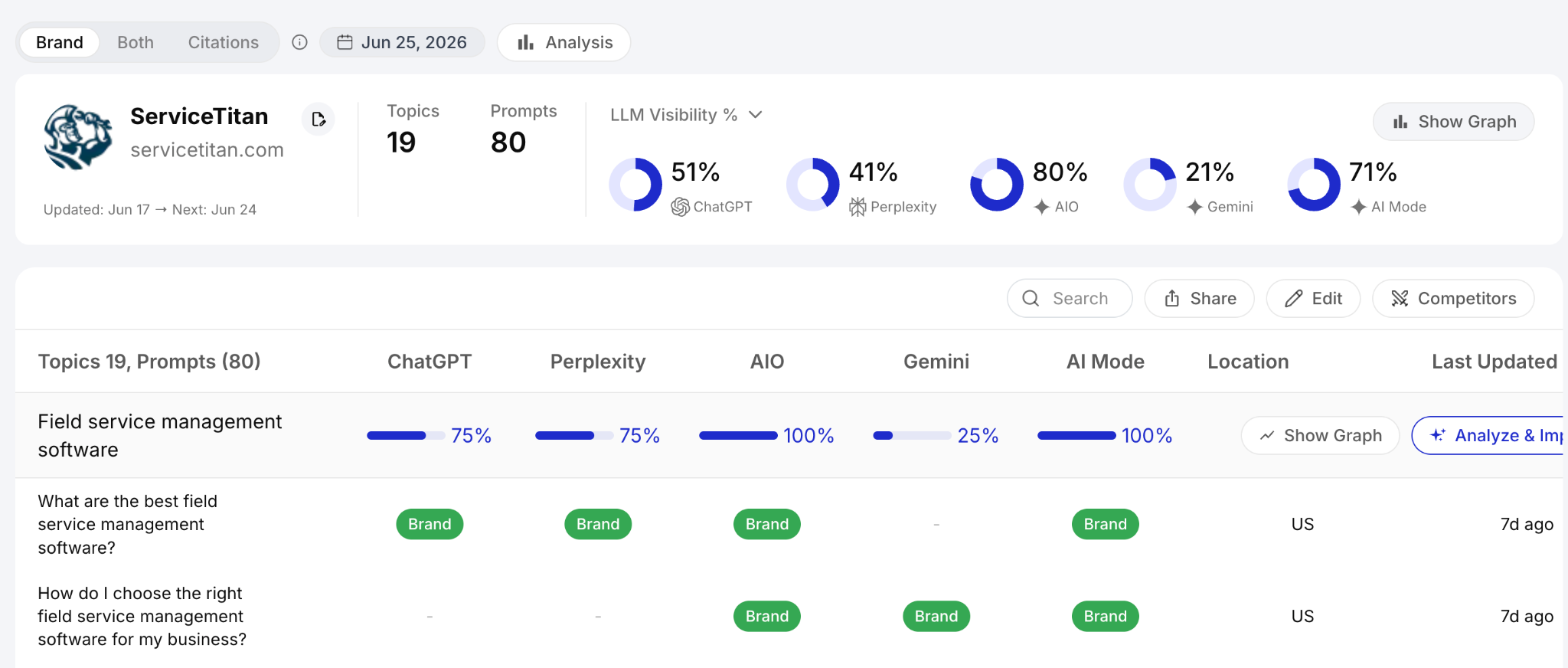
We also scrape real web interfaces rather than calling APIs. This demanded significant development work, as LLMs actively resist being scraped, but the data more closely reflects what users actually see in the Perplexity product, rather than what the API returns in isolation.
Traqer separates brand mentions from citations at the topic level and the prompt level. The toggle at the top of every brand page lets you switch between counting only brand mentions, only citations, or both. For Perplexity, given how citation-heavy its responses tend to be, this toggle is particularly useful: it tells you whether you're being cited as a source or actually recommended.
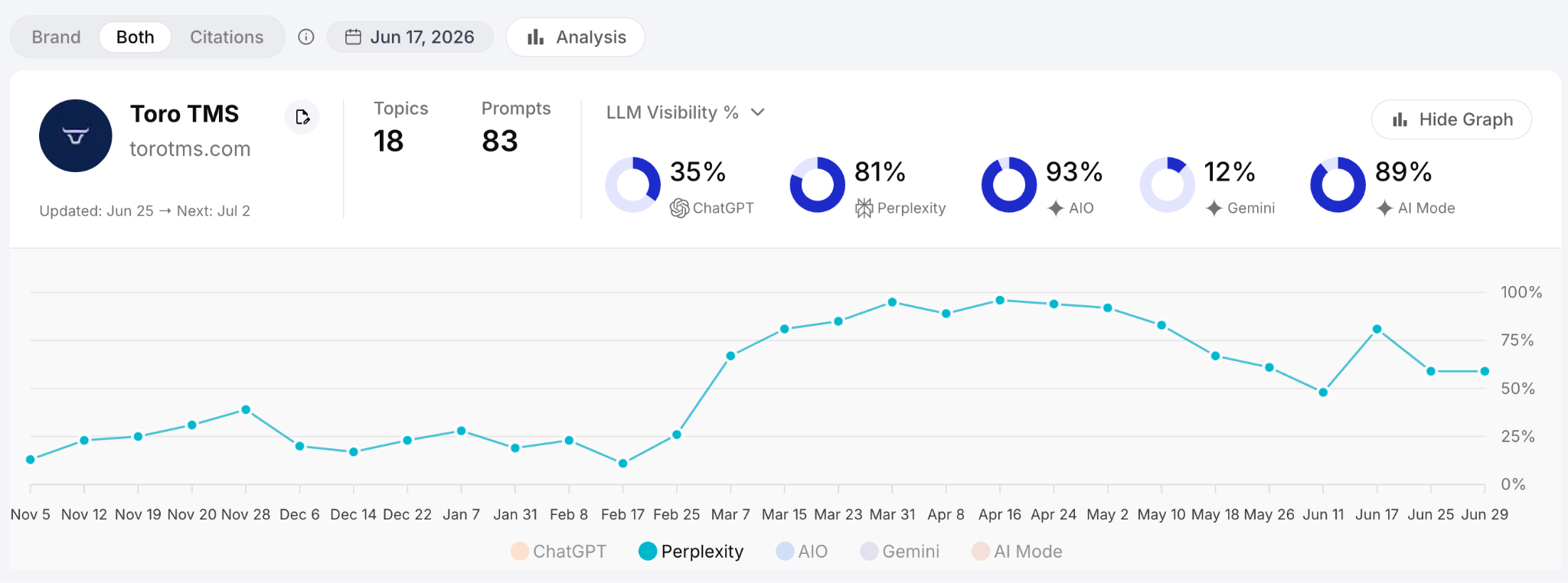
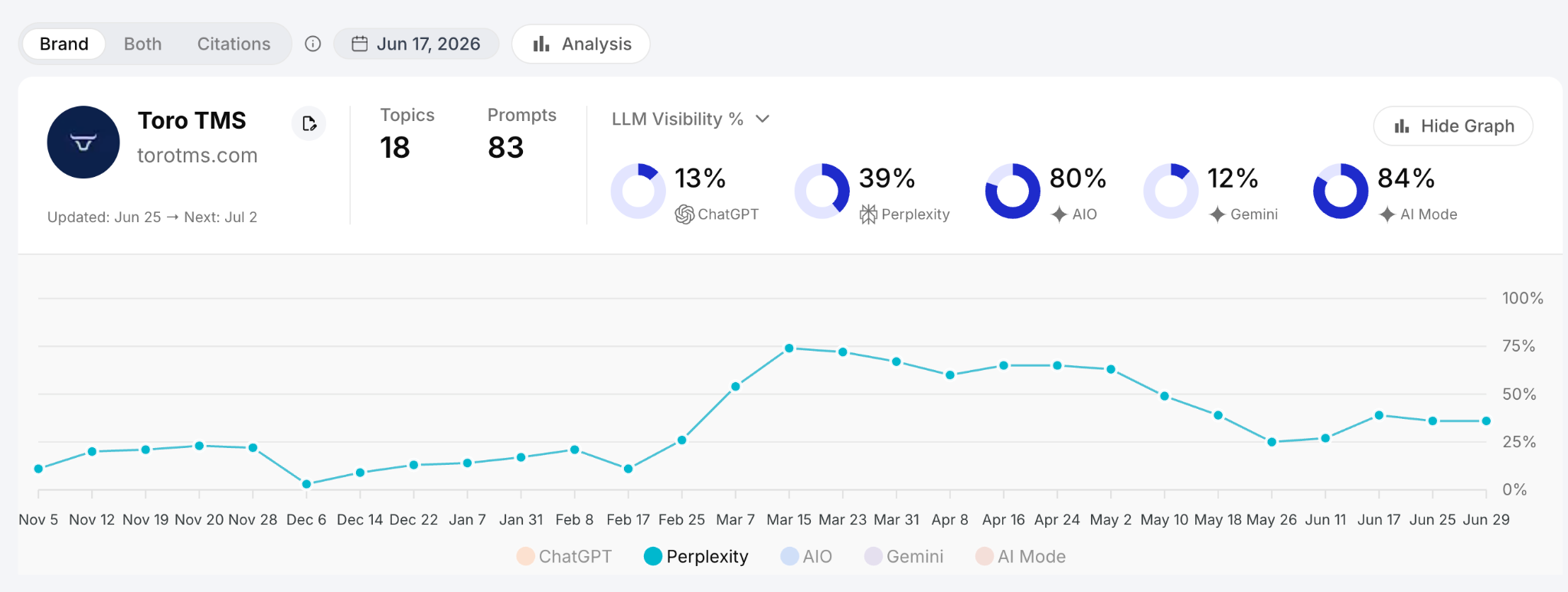
Two brands in Traqer show what this looks like in practice. Toro TMS, a trucking management software company, shows 81% Perplexity visibility on a combined basis across 91 prompts, well above its 34% on ChatGPT. Switch to brand mentions only and Perplexity drops to 39%. More than half of what reads as strong Perplexity performance is citation-based: Perplexity is pulling from Toro's content as a source, but not consistently naming the brand in its answers.
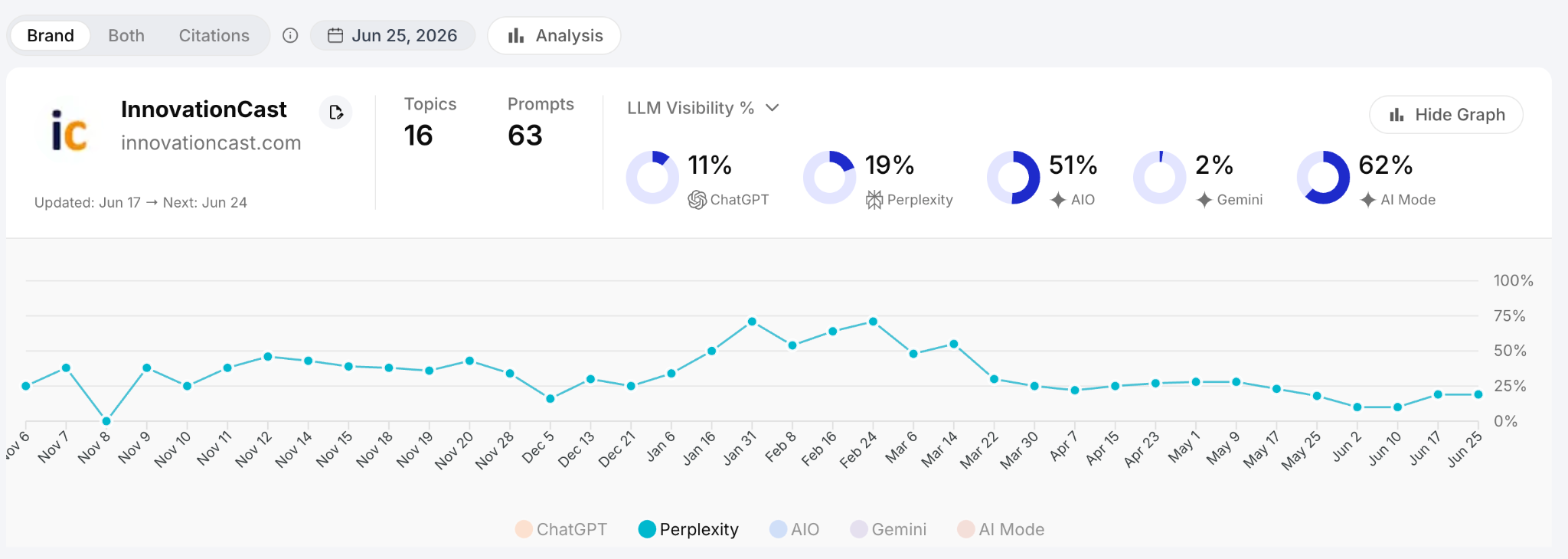
Another brand, InnovationCast, shows the same pattern even more sharply: 67% when combined, 19% on brand mentions only. Without the toggle, you'd read both as performing reasonably on Perplexity. With it, you'd see brands that Perplexity cites frequently but rarely recommends by name.
At the brand level, Traqer gives you three visibility metrics:
LLM Visibility %: The share of all tracked prompts where your brand appears, shown separately for each LLM.
LLM Visibility Count: The raw number of prompts where your brand appears, per LLM. This number only goes up when visibility genuinely improves.
Topic Visibility: The number of topics where your brand has some (>0%) or high (>50%) visibility.
LLM Visibility Count and Topic Visibility don't move unless something real happens. They can't be gamed by adding or removing prompts.
Each tracked prompt links to a screenshot of the actual response from the real web interface. When a client asks whether they're really appearing in Perplexity for a given topic, you can show them exactly what a user sees when they type that prompt.
Traqer also has an Analyze and Improve view for each topic, showing which brands appear most often in LLM responses, which domains and URLs get cited, and a Brand Mention Probability rating for each prompt. The probability rating (High, Medium, or Low) identifies which prompts are genuinely worth tracking and which are informational queries where Perplexity doesn't mention brands regardless of how well you rank.
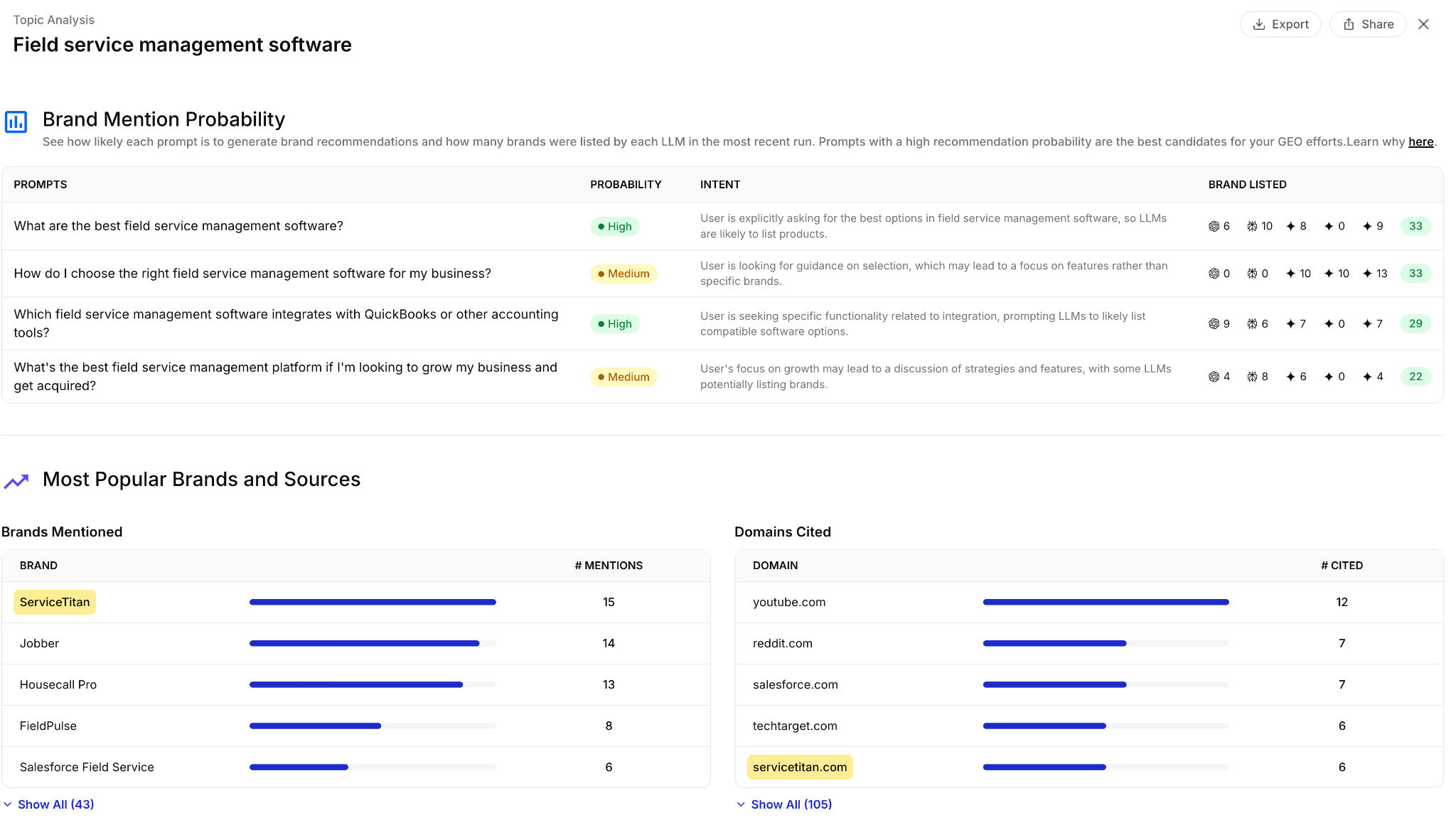
Pricing starts at $25/month for 10 topics and 50 prompts. Unlimited brands and unlimited users at every plan level. All five LLMs are included with no per-LLM charge.
Scrunch
Scrunch covers AI visibility monitoring across multiple LLMs and has expanded into broader territory, including bot traffic analysis, site mapping, and citation discovery.
The citation discovery angle is particularly relevant for Perplexity tracking given how URL-specific Perplexity's responses are. Scrunch's pricing starts at around $250-300/month, making it one of the pricier options at the lower end of its plan range. It's best suited to teams with a heftier budget who want a monitoring platform with a broader feature set beyond prompt tracking.
Profound
Profound is one of the most well-known platforms in the AI visibility space, with $96 million raised and a customer list that includes Ramp, DocuSign, and Figma. It covers Perplexity alongside other LLMs with polished reporting designed for large in-house marketing teams.
Pricing starts at $99/month for a Starter plan that covers ChatGPT only, with the Growth plan at $399/month adding Perplexity and Google AI Overviews. The Lite plan at $499/month expands platform coverage further, and Enterprise is custom-quoted. It's built for enterprise teams with a need for polished stakeholder reporting and deep platform coverage.
Peec
Peec uses UI scraping rather than APIs, which means visibility data reflects what users actually see rather than what the API returns. The interface is polished, with competitive benchmarking suited to organizations managing multi-market campaigns. Base plans cover three LLMs, with additional models available as paid add-ons. Check pricing directly, as plan structures are updated regularly.
Otterly
Otterly covers Perplexity alongside other LLMs including Google AI Overviews, Gemini, and Copilot. Setup is straightforward, the interface is clean, and pricing starts at $29/month.
The approach to tracking is prompt-based rather than topic-based, which is a different methodology to Traqer's. Otterly has been actively developing the product, adding GEO audits, content recommendations, and API access, so it's worth evaluating on current features.
What actually impacts your Perplexity visibility
Because Perplexity is search-based, the levers are arguably more familiar than they are for ChatGPT or other LLMs. Put simply: owned content that ranks in traditional search tends to get cited.
Traqer's Analyze and Improve view shows whether your domain is appearing in the sources Perplexity pulls from for each topic. If it isn't, that's where content strategy makes a difference:
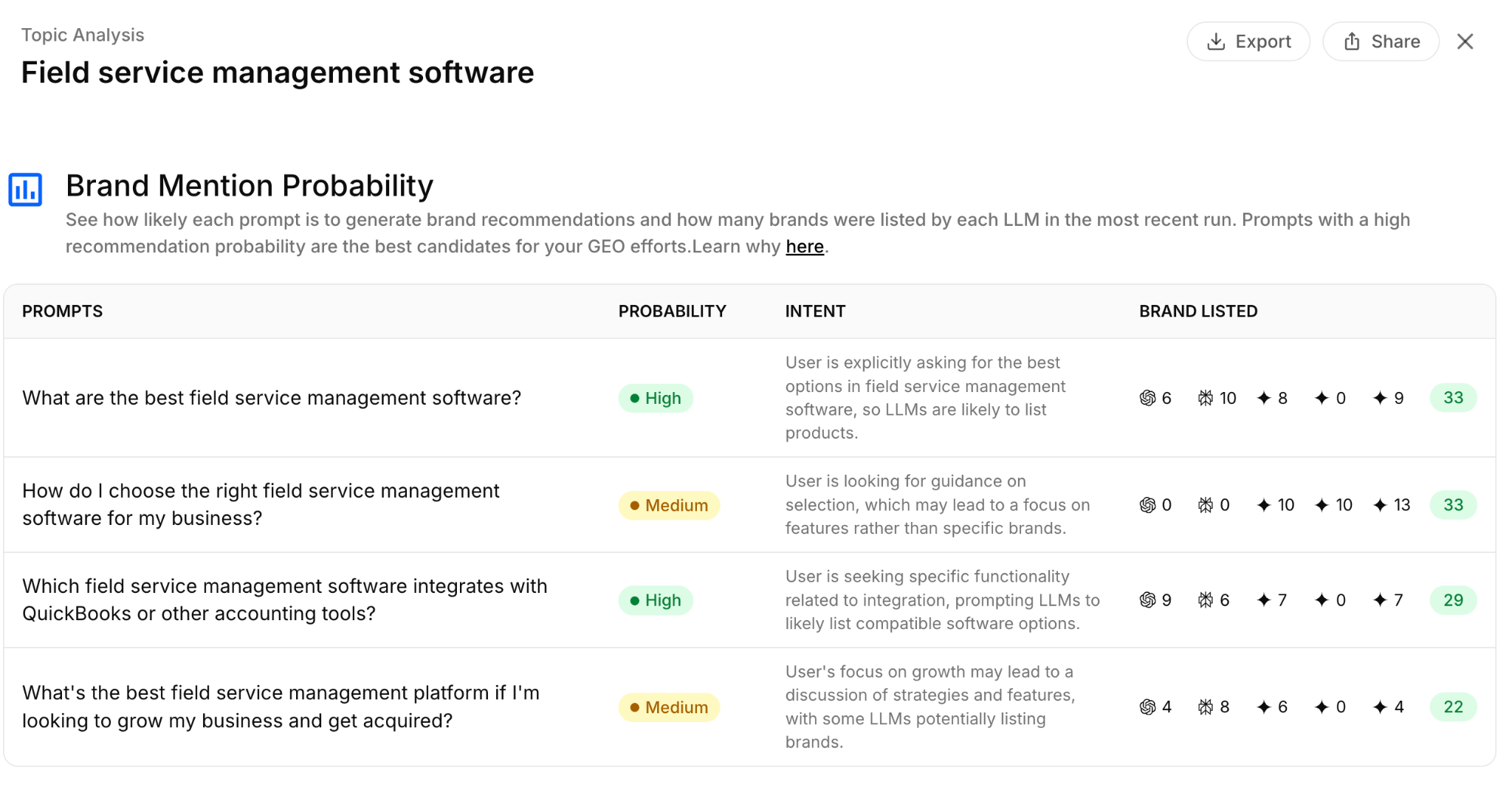
It matters to get mentioned on the sites Perplexity already cites. Again, Traqer shows you which pages are appearing repeatedly across prompts for each topic, whether they're review sites, comparison articles, or industry publications. Those are the places to prioritize for outreach, because Perplexity already draws from them. This echoes SEO link-building, but what's being signaled is different: in AI search, third-party mentions signal that your brand is recognized in a category by sources other than yourself.
Perplexity's citation data makes this unusually actionable. Because Perplexity surfaces specific URLs, you can see not just which domains it trusts for your category but which individual pages. That level of specificity gives you an outreach target list that's grounded in how Perplexity actually makes its decisions, rather than guesswork about what might influence it.
Which Perplexity tracking tool fits your situation
The right tool depends on what you need from the data. Traqer is built around topic-based tracking, real web interface data, and the brand mentions/citations split, with per-LLM breakdowns and unlimited brands at $25/month. It works for single brands and multi-brand tracking alike.
Profound and Peec are built for teams that need enterprise-grade reporting and broader platform coverage, with pricing to match. Scrunch is worth evaluating if citation discovery and content gap analysis are the primary use case, particularly for Perplexity given how citation-heavy its responses tend to be. Otterly is a lower-cost entry point if you're starting out and want to get a basic read on Perplexity visibility before committing to a more involved setup.
Whichever tool you evaluate, the questions that matter most remain the same: does it track topics or individual prompts, how does it collect its data, and does it separate brand mentions from citations? For Perplexity specifically, that last one matters more than anywhere else.