
When Perplexity answers a product question, your brand can appear in two different ways. It can be named in the text of the answer as one of the options worth considering, or it can show up as a numbered citation, one of the sources Perplexity used to build the answer. These might seem similar, but one is a recommendation the reader sees and the other is a source working behind the answer.
It is the named mentions that tell you how often Perplexity recommends your brand. Citations count something else. A number that counts both together measures something broader than recommendations, and on Perplexity it tends to sit noticeably higher than the mention count on its own.
We track Perplexity for clients in Traqer alongside the other main LLM platforms, and in our data the mention count and the citation count diverge more on Perplexity than on the other platforms we track. This article explains what drives that, and how you can track brand mentions so your numbers reflect whether Perplexity is recommending you rather than only citing you.
(For the broader method that applies across every platform, see how to track brand mentions in AI search. If you are choosing a tool, see our guide to Perplexity rank tracking.)
Brand mentions and citations aren’t the same thing
Every Perplexity answer comes with inline citations. Ask it for the best options in a category and it writes a few paragraphs, each footnoted with the sources it drew from, and a list of those sources alongside. Your brand can show up in two separate places in that response, and they mean different things.
A citation means your page was one of the sources Perplexity used to write the answer. Your URL is in the list. That tells you your content is good enough, and accessible enough, for Perplexity to build its answer on. It does not mean Perplexity told the reader to consider you.
A brand mention means Perplexity named you in the answer itself, as one of the options it is putting in front of the reader. This is more valuable from a conversion perspective, because the reader sees your name presented as a recommendation rather than buried in a source list they may never open.
Both are worth tracking, for different reasons. Perplexity attaches clickable citations to its answers, so being cited can send you referral traffic even when your brand isn't named in the text, and that traffic can appear in your analytics as visits from perplexity.ai. Most citations never get clicked, so the traffic is smaller than it first appears, but it is real. That's why a citation has some value on its own as a source of visits, separate from a brand mention, which is the signal that Perplexity is recommending you.
It is worth keeping that referral traffic in perspective. Traffic on its own has never been the right goal. The Pain Point SEO approach values qualified, conversion-ready visitors who are likely to turn into revenue, not visits for their own sake. A few clicks from a citation are a minor bonus. The brand mention matters far more, because being named as a recommendation to a buyer who is actively comparing options is what puts qualified prospects in front of you. That’s the metric to focus on, and the one this article is about.
Perplexity's use of citations and brand mentions
Perplexity cites a source for almost everything it says. This means citations can be relatively easy to come by, especially if you already have strong Google and/or Bing rankings. But, importantly, only some of these citations will also name your brand in the answer.
For example, Climb Hire, a US-based workforce development nonprofit, shows 68% Perplexity visibility across 56 prompts when you combine brand mentions and citations. This is comfortably ahead of its 29% on ChatGPT. But if we switch the same data to brand mentions only, Perplexity drops to 23%.
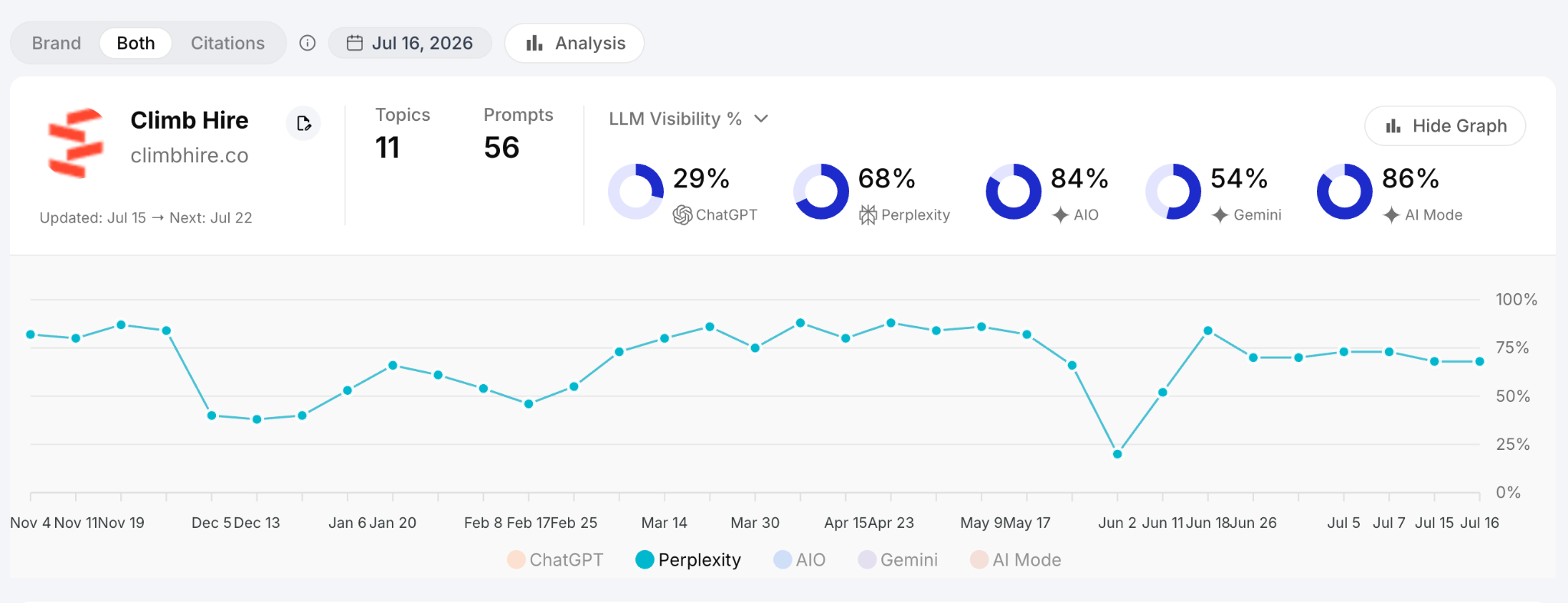
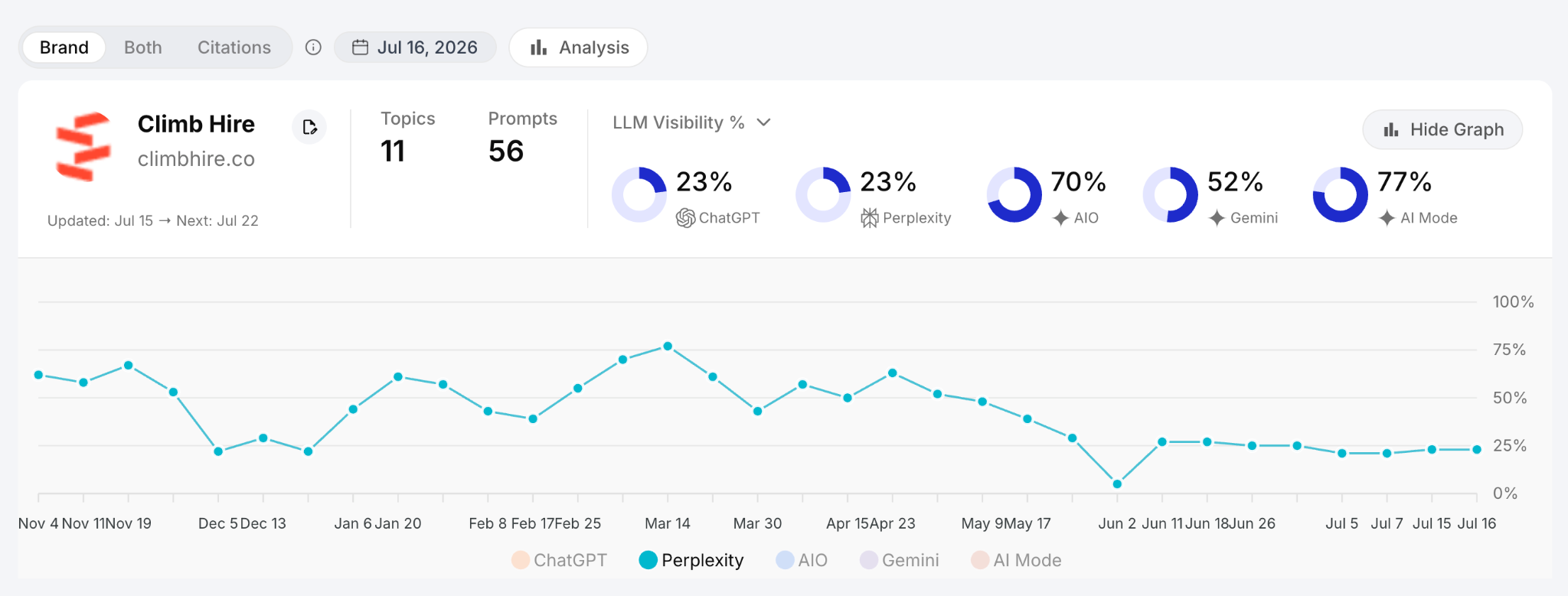
In this case, much of what looked like very strong Perplexity performance is actually Perplexity citing Climb Hire’s content without naming the brand in the answer.
This occurs at the platform level too. When we compared visibility across the LLMs we track, Perplexity sat in a middle tier on combined visibility, above ChatGPT and below Google AI Overviews. On brand mentions alone it fell to the bottom tier, alongside ChatGPT.
Perplexity, put simply, produces lots of citations and far fewer named recommendations. That is essential to understand before you track it, because a tool reporting combined visibility will show Perplexity as one of your stronger platforms. But on the metric that is likely to drive leads for your business (brand mentions), it may actually be one of your weaker ones.
Why tracking one specific prompt on Perplexity doesn't help
Once you're measuring the right thing (brand mentions), the next problem is that Perplexity doesn't give you a stable answer to measure. It runs a new search for each query against a continuously updating index and then generates its answer probabilistically, so the same prompt run twice can return different citations, a different set of brands, and different phrasing.
A separate factor sits on top of that variability. A logged-in user's answer can be personalized in ways a tracking tool cannot see. Perplexity added a memory feature in late 2025 that stores a user's stated preferences and past searches and uses them to tailor future answers, and it switches that off in incognito mode. This personalization is more limited than the deep, cross-session context a chatbot like ChatGPT builds up, and it is a smaller source of variation on Perplexity than the run-to-run instability, but it is real.
We call the general version of this the invisible prompts problem, and on Perplexity it means a single-prompt check in a neutral session tells you how Perplexity answered one phrasing on one run, not exactly what a logged-in buyer sees.
The sensible response here is to track by topic rather than by single prompt.
Group several prompt variations that approach the same buying-intent question from different angles, run them all, and report how often your brand is mentioned across the set. A single noisy result then stops distorting the picture, and you get a number that better represents your chance of being named when a real person asks about that topic. This is more accurate than single-prompt tracking. It's not complete, because nothing in AI visibility measurement ever captures the personalized answers real users receive, but it's a lot better than tracking a single keyword or key phrase in isolation.
How to track brand mentions in Perplexity
Beyond twenty or thirty prompts, or once you want a reliable measurement over time, manual tracking becomes too slow and noisy to maintain, and a tool that separates mentions from citations is the realistic option. (For how the tools compare, see our Perplexity rank tracking guide.)
Get an AI visibility tool that tracks Perplexity. This is the obvious first step.
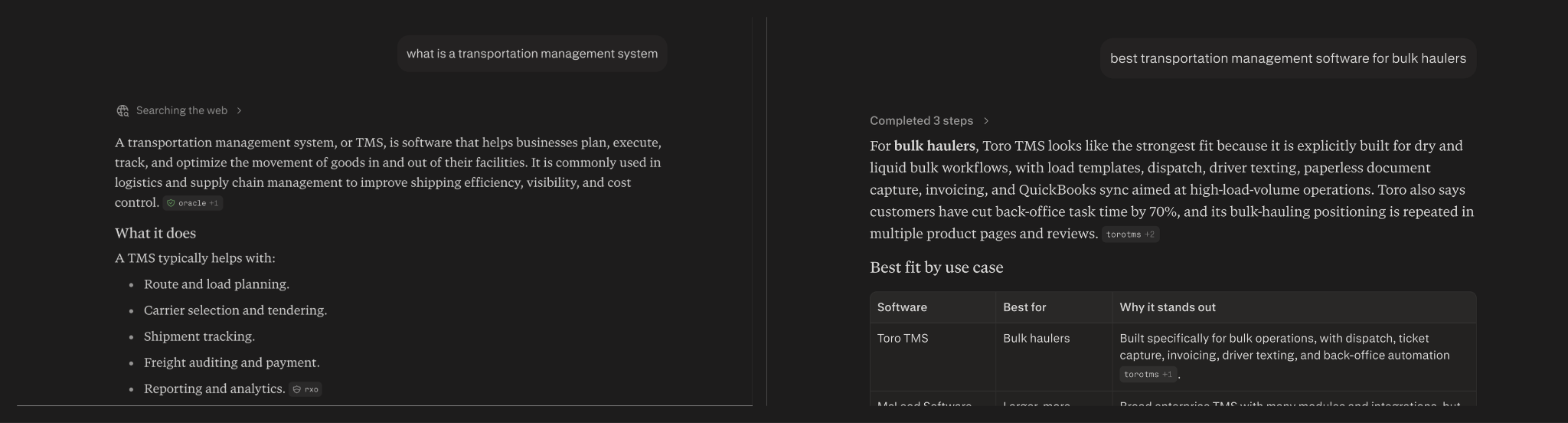
Start tracking topics where Perplexity is likely to name a brand. Perplexity doesn't name brands when the query is informational. Ask it what a transportation management system is and it usually explains the concept without recommending anyone. Ask it for the "best transportation management software for bulk haulers" and it names products (brands).
Start with bottom-of-funnel, product-centric topics where your buyers are choosing between options, which is where nearly all AI brand visibility comes from. (Note: Traqer rates each prompt by how likely it is to produce a brand recommendation.)
Run several prompts per topic and average them. Perplexity's answer changes from one run to the next. So for each topic, ask the same question a few different ways and see how often you get mentioned across all of them, instead of trusting a single result. Even that only tells you about one moment in time. To get a number you can rely on, you have to run the same prompts again over time and watch the average. This is the part Traqer is built to do. It reruns the same set of prompts for each topic (on a real Perplexity session, not an API) on a schedule, and shows your mention rate for that topic. This means you're not copying screenshots into a spreadsheet or wondering whether your number moved because Perplexity changed or because you worded the question differently.
Track by topic over time, per platform. The valuable insights are found in trends, which means tracking your mention rate by topic week over week is the right approach. Keep Perplexity separate from your other platforms rather than blending everything into one "LLM visibility" metric.
How brand mention data informs content strategy
A strong citation rate with a weak brand mention rate is the common pattern on Perplexity. It means that Perplexity trusts your content enough to build its answers on it, but you're not being named as a recommendation for the associated bottom-of-funnel queries. The fix here is about content strategy rather than tracking, and the Prioritized GEO framework sets the order to work in.
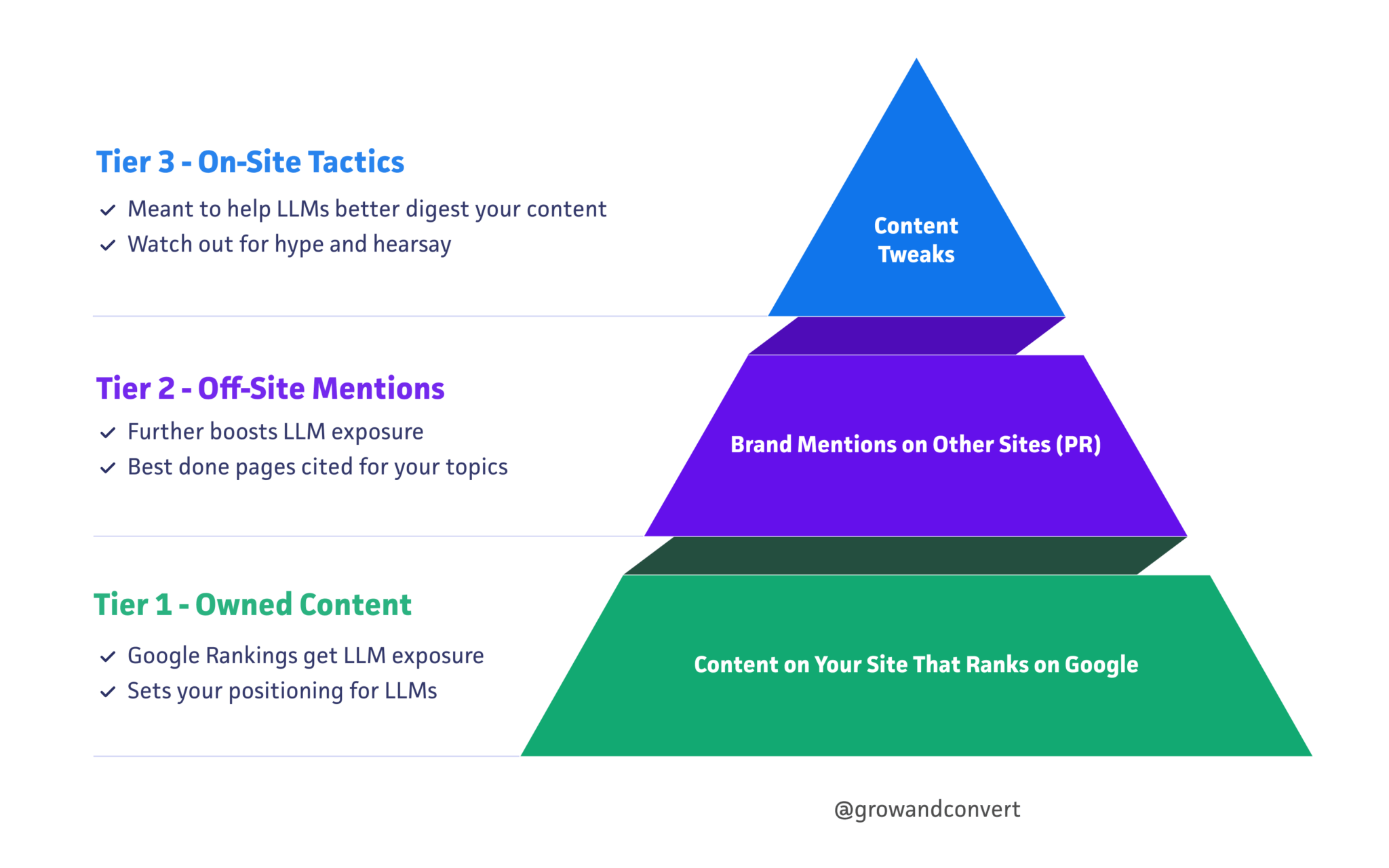
The first priority is your own content. For the topic areas where you're receiving citations but you’re not named as a recommended brand, the usual cause is that your content explains the category well but doesn’t make a clear case for your own product. The work is to build or rewrite that content so it states clearly who your product is for, the specific problem it solves, and why it is the right choice. This is Topic-Based GEO in practice; mapping every product angle that matters and producing deep, expert-informed content.
The second priority is off-site mentions. Being named as a brand on the third-party pages Perplexity already cites for a topic gives it another path. It comes second because your own content earns both the citation and the mention, while a mention on someone else's page mainly adds exposure.
The on-page layer that most GEO advice fixates on, the llms.txt files, schema, and FAQ formatting, sits at the bottom of the list (or the top of the pyramid). Those tactics try to help Perplexity digest content it has already found. They do little to turn a citation into a recommendation.
Track Perplexity for your own brand
Start tracking your Perplexity brand mentions in Traqer. It keeps mentions and citations separate and reports them by topic, from the real Perplexity interface, so you can see how often Perplexity recommends your brand rather than guessing from a combined score.