
As ChatGPT (and other LLMs) continue to drive more and more visitors to your site, it’s natural to want to track performance. The instinct then is to reach for a familiar concept: rank tracking. However, tracking ChatGPT visibility isn’t quite the same as monitoring SEO keyword rankings. In fact, there are actually no “rankings” at all in ChatGPT.
This article explains what it actually requires, and why many tools out there fall short on giving you accurate information. I’ll introduce our platform, Traqer, and explain what we built differently and why. We also show how it stacks up against the other ChatGPT tracking tools.
Why “rank tracking” doesn’t translate directly to ChatGPT
Give or take, the same Google search query produces roughly the same results for roughly the same user. While there is some personalization happening in the SERPs, the results are somewhat stable and you can get a good idea from rank trackers where you’re appearing.
LLMs, including ChatGPT, don’t work that way. If you run the same prompt ten times you’ll get ten different responses. There’ll be different brands mentioned, different framing, and sometimes an entirely different set of recommendations.
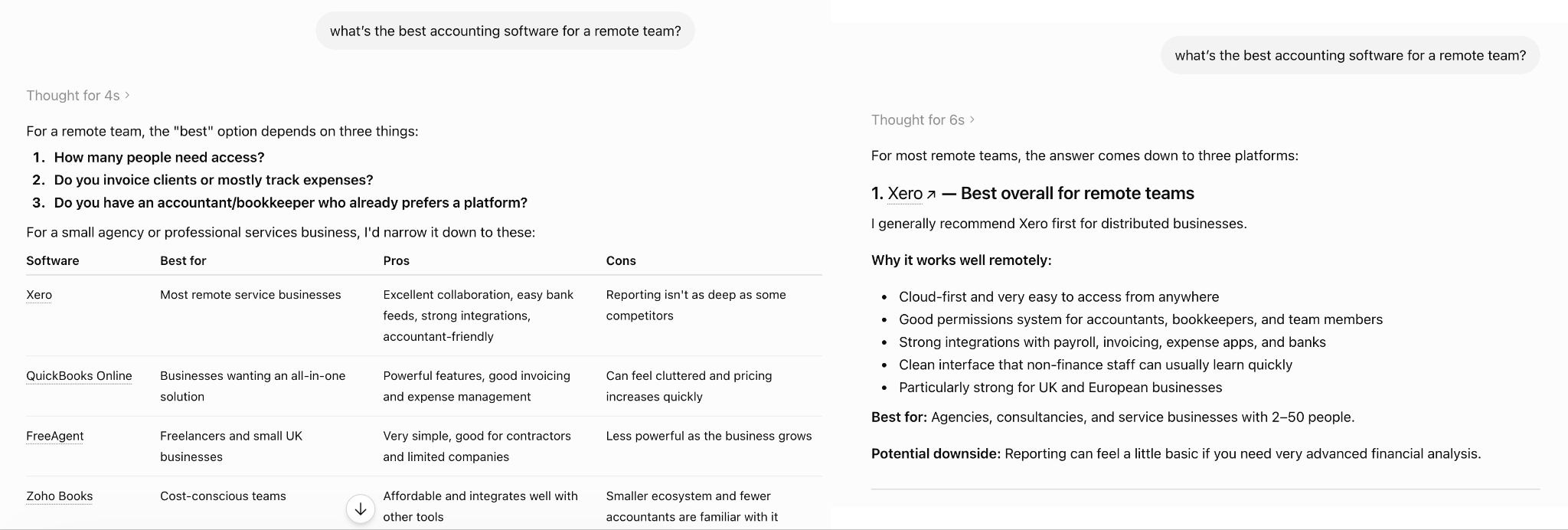
If you ask ChatGPT “what’s the best accounting software for a remote team?” you might get Xero in one answer, QuickBooks in the next, and a response that skips product recommendations altogether in the one after that. There’s no fixed output, which means there’s no fixed “ranking” position that you can track over time. This is how LLMs are designed. They generate responses probabilistically, influenced by training data, conversation history, user background, and the specific phrasing of each prompt.
There's a second issue on top of this. When a real user asks ChatGPT a question, the literal prompt is not the full picture of what the model is working with. LLMs draw on months or years of prior conversation history, saved context, and personal preferences to shape their responses. A question that reads as six words on screen will be carrying pages of additional context the model already knows about that user.
We've written about this in detail in our piece on Invisible Prompts. One example from our own experience: a client asked ChatGPT for the best SEO companies. Her literal prompt was brief and casual. But ChatGPT already knew her industry, her company size, and her goals from months of prior conversations, and it recommended Grow and Convert on the basis of all that invisible context. When Benji (our co-founder) asked the same question from his own account, the answer was completely different.
This isn't the same phenomenon as output variability. Variability means the same user asking the same question again gets a slightly different response. The invisible prompts issue means two different users asking what looks like the same question are, in practice, asking meaningfully different things. No visibility tool can replicate that context, which is another reason a single prompt result tells you very little.
What can you track instead?
What you can actually measure, we propose, is something more like a visibility rate.
Across a range of prompts that approach the same topic from different angles, how often does your brand get mentioned? That’s a meaningful signal that gives you an idea for how you’re performing.
The unit of analysis, we argue, should be the topic, not a single prompt. This is the proper response to both problems described above: output variability means any single prompt run gives you noisy data, and the invisible prompts issue means no single prompt can represent what real users are actually asking.
Tracking a topic across multiple prompt variations gives you a directional picture that neither problem can undermine.
A topic, from this perspective, is a buying-intent area that your customers might ask ChatGPT about. Something in the realm of “the best bookkeeping software for small businesses” or “best tool for managing my restaurant accounts.”
Within this topic area, you should track multiple prompts. Then, you can look at how often your brand appears across all of them, and track that over time. “You showed up in 7 of 10 prompts on Perplexity and 3 of 10 on ChatGPT for this topic” is data you can actually do something with.
This is the concept we’ve built our tool around. Any tool that gives you a stable position number for a single prompt is providing misleading information.
Important things to look for in a ChatGPT tracking tool
First and foremost, your tracking tool should track by topic rather than by individual prompt. But more than this, we believe a tracking tool should:
Use real web interfaces rather than API responses. Not to get too technical here, but most tools query LLMs through their APIs because it’s cheaper, faster, and easier to scale. But the problem is that this doesn’t reflect the real user experience. LLM web products layer system prompts, interface tuning, and model configurations on top of the base model. The result is that a brand appearing in an API response may not appear when a real user types a prompt into ChatGPT, and vice versa.
Separate brand mentions from citations. A brand mention means ChatGPT named your brand in its recommendation: “for that use case, you might want to look at Xero.” A citation means your URL appeared in ChatGPT as a source link at the bottom of the response. These aren’t the same thing, and they don’t have equal value. A tool that blends both into a single visibility score hides a strategically important distinction.
Separate different LLMs. A tool that averages visibility across all LLMs into a single number makes key differences between those platforms invisible. You need to know whether you’re strong on Perplexity but absent from ChatGPT, because it can help you adapt your content strategy.
The pricing structure is also a big deal. From our direct experience as an agency trying to track LLM visibility for dozens of clients, lots of tools charge per brand and per LLM model. This adds up quickly as you add clients. To learn more about AI visibility tracking tools for agencies, read our post on AI visibility tracking tools for agencies.
How ChatGPT tracking tools compare
1. Traqer
Traqer is our own tool, which we built to track client visibility in ChatGPT and the other LLMs. We developed Traqer after trying the other tools out there and facing two issues repeatedly:
The pricing was prohibitive, and;
The measurement wasn’t accurate because the tools were trying to track individual prompts; and they were also combining everything into a single visibility percentage.
This meant we were paying way too much for information that was hard to trust.
We built Traqer to measure LLM visibility the way it should actually be measured: at the topic level, per LLM, with brand mentions and citations separated, and with data pulled from real web interfaces rather than APIs.
How Traqer works:
You set up a brand in Traqer by entering your domain, a description of your product, your target customers, and your key differentiators. Traqer then suggests topics, which are buying-intent queries your customers may be entering into ChatGPT.
These are suggestions to get you started, but we recommend you and your team decide which bottom of the funnel topics are most important for your brand and add or remove topics accordingly, at this step. Then, multiple prompts are generated automatically for each topic, which you can also edit or replace.
Each topic tracks a set of prompts across ChatGPT, Perplexity, Google AI Overviews, and Gemini simultaneously. Visibility is reported as the percentage of those prompts where your brand appears, broken out per LLM. This would be useful, for instance, if you see that a topic shows 70% visibility on Perplexity but just 20% on ChatGPT. In this case, you’d know that you have good search visibility, but ChatGPT’s training data doesn’t appear to be picking you up as well.
It then makes sense to focus on getting mentioned on third-party sites and publications that ChatGPT is already citing for that topic (visible in the Analyze & Improve view, outlined below), and to produce more owned content that explicitly associates your brand with the topic.
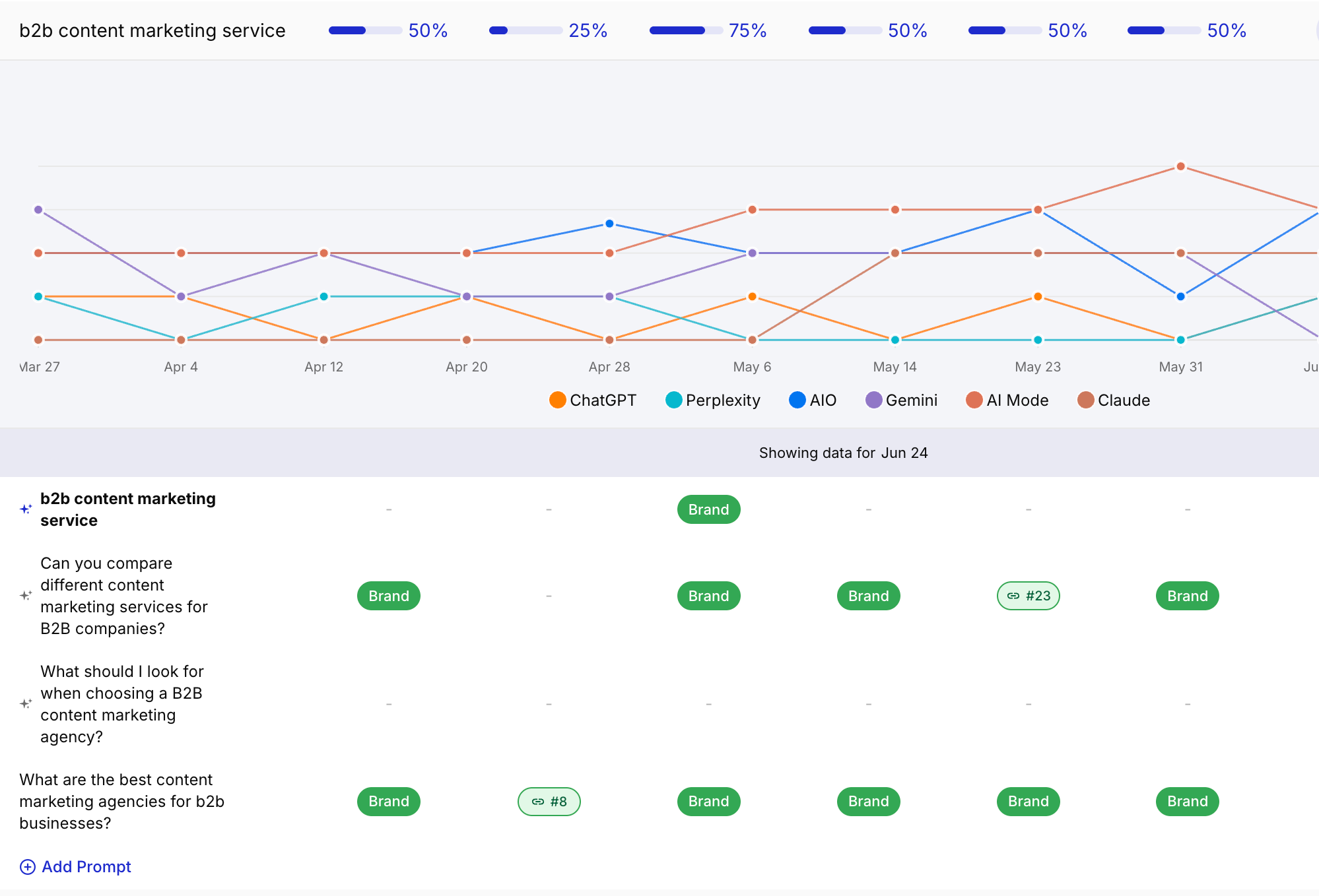
At the brand level, Traqer offers three visibility metrics:
LLM Visibility %: The share of all tracked prompts where your brand appears, shown separately for each LLM. Similar to what other tools report, but not blended across models.
LLM Visibility Count: The raw number of prompts where your brand appears, per LLM. This number only goes up when visibility genuinely improves.
Topic Visibility: The number of topics where your brand has some (>0%) or high (>50%) visibility. Adding new topics you don’t yet rank for doesn’t drag this down.
LLM Visibility Count and Topic Visibility don’t move unless something real happens; they can’t be gamed by adding or removing prompts.
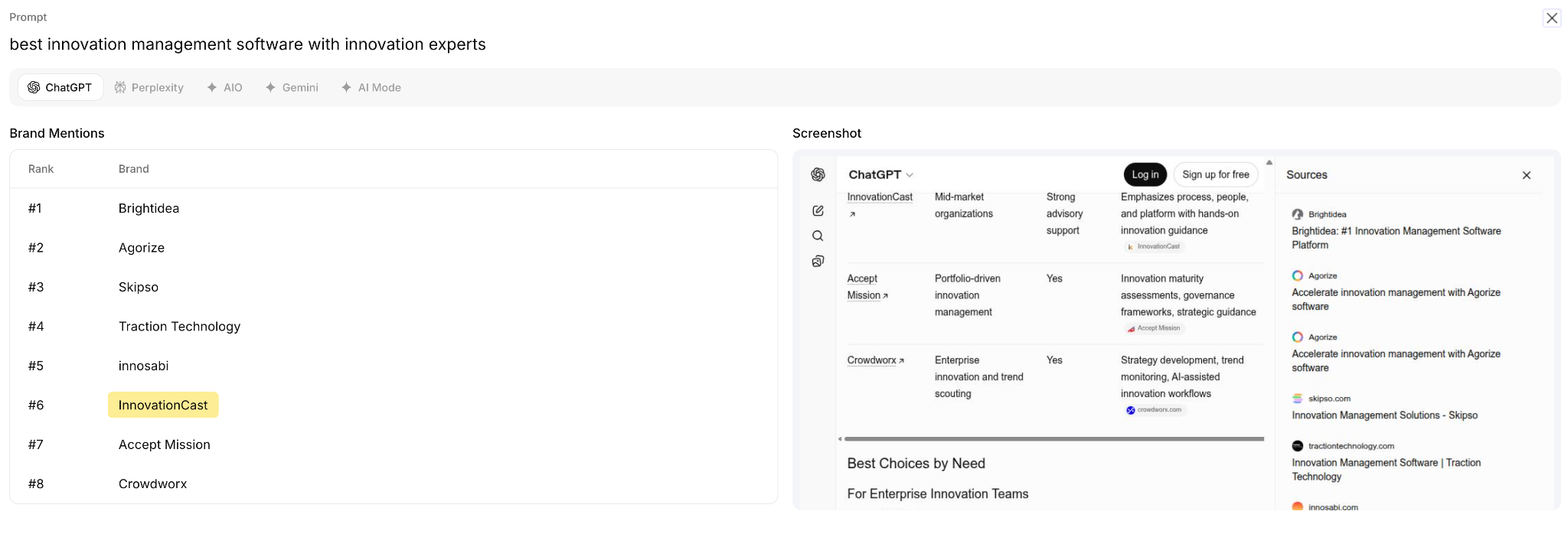
Each tracked prompt links to a screenshot of the actual response from the real web interface. When a client asks “are we really appearing in ChatGPT for this?” you can show them a real example of what a user will see when they type that prompt.
Analyze & Improve
Each topic has an Analyze & Improve view that shows which brands LLMs mention most often for that topic, which domains are being cited, and which specific pages are appearing more than once.
This is the data that tells you what to do next: which publications to target for outreach, which topics need more owned content, which prompts appear to be informational rather than product-intent (and probably aren’t worth tracking).
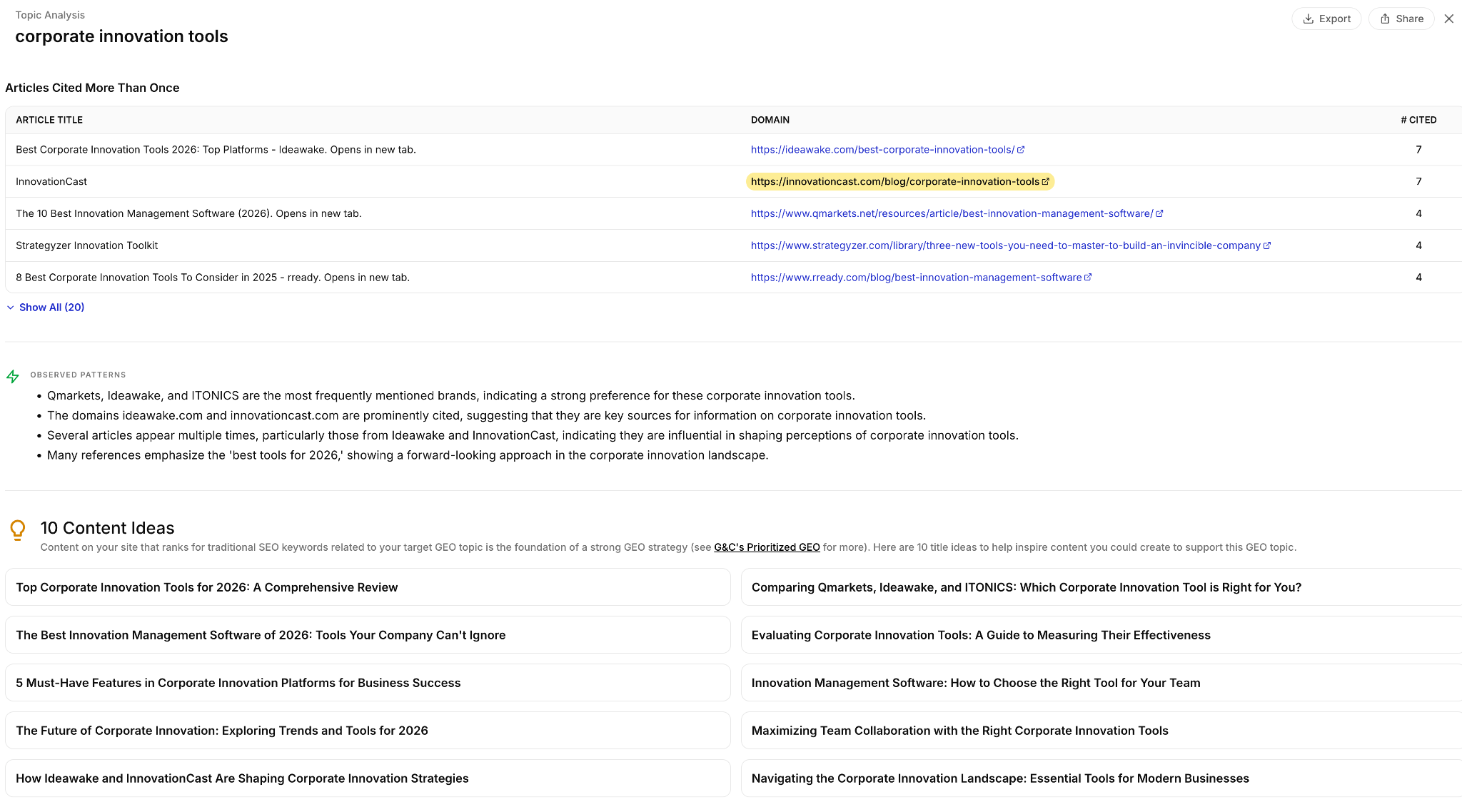
Traqer also has a Brand Mention Probability rating for each prompt, measured at High, Medium, or Low. This flags which prompts are likely to generate product recommendations, and aren’t. The distinction is important because LLMs behave differently depending on how a question is framed.
For instance, if you ask ChatGPT "how does project management software work?" it will explain concepts without recommending anything specific. Ask "what's the best project management software for a remote team under 20 people?" and you’ll get a list of tools.
If you track both types of prompt together without differentiation, you'll be measuring a lot of responses where brands were never likely to appear. This drags your visibility rate down and tells you nothing about whether your actual strategy is working or not.
Pricing
Traqer starts at $25/month for 10 topics and 50 prompts. Every plan includes unlimited brands and unlimited users, and all five LLMs (ChatGPT, Perplexity, Google AI Overviews, Gemini, and Claude). Pricing scales with prompt volume, not with the number of brands or clients you’re tracking. For an agency with 20 clients, each tracking a handful of topics, Traqer’s economics are substantially different from per-brand tools. The math usually works out to a fraction of the cost.
Who it’s right for: B2B SaaS brands, marketing leaders who want to understand their AI search position across multiple platforms, and agencies managing multiple client brands. It’s not designed for real-time alerting or high-frequency prompt monitoring because the weekly refresh cadence is built for strategic visibility tracking, not hourly checks. Start tracking ChatGPT with Traqer now.
2. Scrunch
Scrunch is designed primarily for content and SEO teams, with features oriented toward discovering which sources LLMs are citing and identifying gaps in your content coverage. If your main deliverable is content strategy (figuring out what to write rather than reporting brand mention rates), it's worth evaluating on those terms. The AI visibility tracking features are present, but they're secondary to the content discovery angle. For teams whose primary need is brand-level visibility monitoring across multiple LLMs, with per-LLM breakdowns and meaningful trend data over time, Scrunch's focus is somewhat different. It sits at the lower end of the market on price, which helps if budget is the primary constraint.
3. Profound
Profound is one of the most established tools in the AI visibility space and is built explicitly for enterprise use. The interface is polished, the LLM coverage is broad, and the reporting features are designed for the kind of stakeholder presentations that larger organizations need.
Two things are worth understanding before committing. First, Profound uses API-based querying rather than real web scraping, which means its data reflects model behavior in a stripped-down environment rather than what users actually see in the ChatGPT or Perplexity interface. Second, pricing scales per brand, which makes it expensive for agencies or companies tracking multiple products. For a single enterprise brand with a real budget and a need for polished reporting, it’s a serious option. For anyone managing multiple brands, the cost structure is a meaningful constraint.
4. Peec
Peec is a VC-backed platform launched in early 2025, aimed at enterprise marketing teams. It uses UI scraping rather than APIs (much like Traqer does), which means visibility data reflects what users actually see rather than what the API returns. The interface is polished, with competitive benchmarking and regional tracking features suited to organizations managing multi-market campaigns.
The main consideration is cost. The Starter plan begins at around $95/month, but that base price covers only three LLMs. Tracking additional models is a paid add-on, and costs can climb quickly depending on which platforms you need. For an enterprise team with budget to match, it's a credible option. For agencies managing multiple brands, or smaller in-house teams, the per-model add-on structure adds friction and cost to what should be a baseline feature.
What actually impacts ChatGPT visibility?
Tracking tells you where you stand. But it’s worth reflecting on what to do with that information once you have it. How does it impact content strategy?
AI search is genuinely less predictable than Google. The relationship between content actions and visibility outcomes isn’t as mechanical, and anyone promising a guaranteed playbook is not telling the truth. That said, based on our work managing GEO for 25+ clients at Grow and Convert, two things show up consistently as levers that seem to be worth pulling.
1. Owned content that ranks in traditional search
Content on your site that ranks for bottom-of-funnel keywords related to a buying-intent topic tends to get cited by AI platforms, particularly Perplexity and Google AI Overviews, which pull from search results. If LLMs are drawing from search, being there is the first step to getting cited. Traqer’s “Domains Cited” data shows whether your domain is appearing in the sources LLMs pull from for each topic. If it isn’t, that’s where the content strategy can start to make a difference.
This is Tier 1 of what we call the GEO Priorities Pyramid: owned content is the foundation.
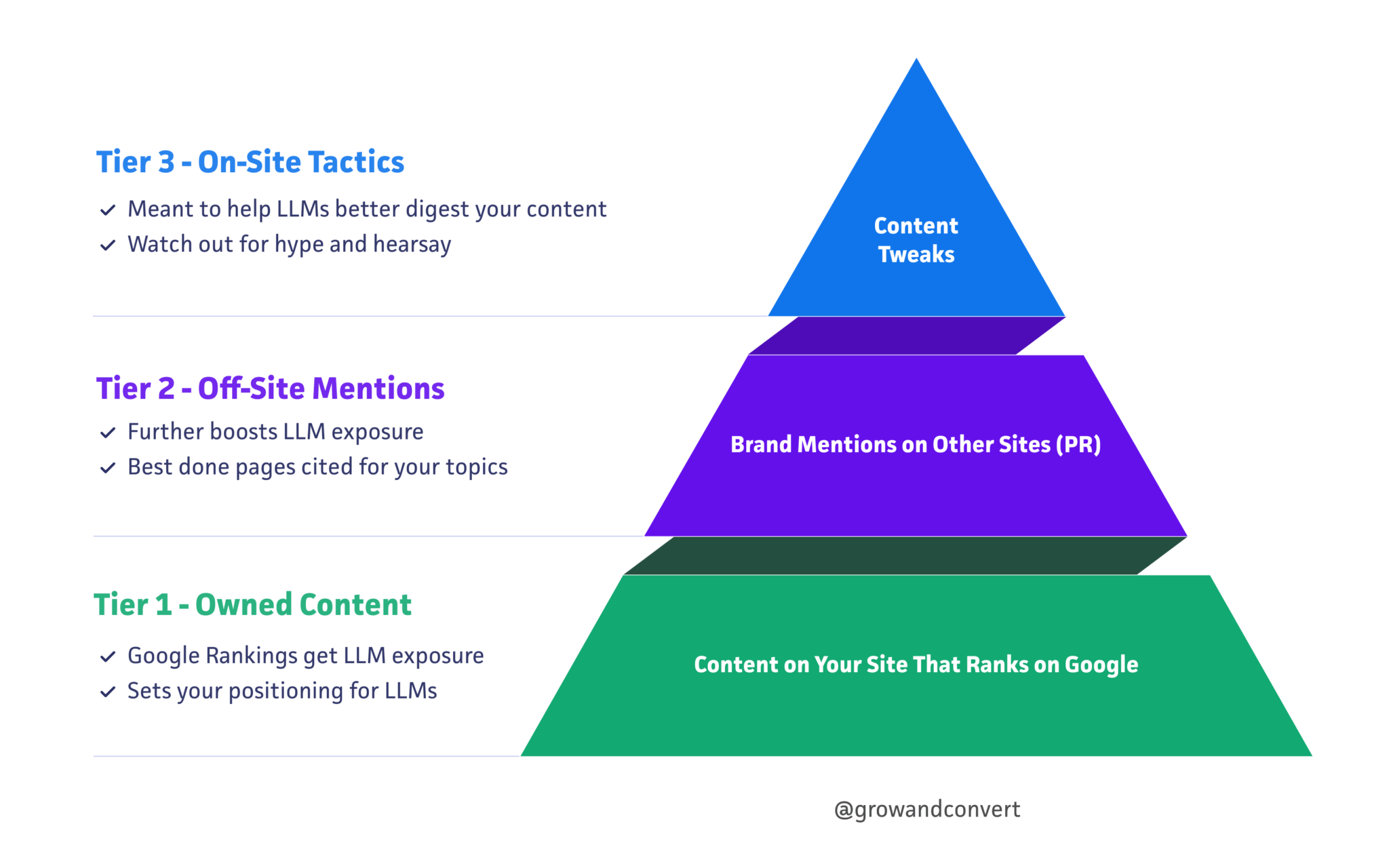
The important caveat is that ranking in Google doesn’t guarantee ChatGPT will mention you. The correlation is clear, especially on search-based LLMs. But it’s not guaranteed. ChatGPT pulls from training data in ways that don’t perfectly mirror search rankings.
2. Getting mentioned on the sites that LLMs already cite
Traqer’s Analyze & Improve view shows which specific pages are appearing repeatedly across prompts for each topic, whether they’re review sites, comparison articles, or industry publications. You’ll want to prioritize your outreach to these websites, because you know ChatGPT is already drawing from them.
This process echoes SEO link-building, but what’s being signaled is subtly different. In SEO, links signal authority. In AI search, third-party mentions signal that your brand is recognized in a category by sources other than yourself. LLMs appear to weight external validation pretty heavily, and this is something that your owned content can’t really affect.
Which ChatGPT tracking tool fits your situation?
If you’re an agency managing multiple client brands and need affordable tracking built around a measurement philosophy you can defend (e.g., topic-based visibility, real web data, brand mentions separated from citations, per-LLM breakdowns) Traqer is built for that. It starts at $25/month with unlimited brands, and runs across all major LLMs.
If you’re an enterprise team with a single brand, a larger budget, and a need for polished stakeholder reporting, Profound and Peec are the options built for that kind of scale, with the trade-offs noted above. If content strategy and citation discovery are your primary concern, rather than visibility monitoring and reporting, Scrunch is worth a look.
Whichever ChatGPT visibility tracking tool you look at, the key questions remain the same:
How affordable is it at scale?
Does it use API data or real web scraping?
How is visibility calculated, and does adding prompts affect it?
Are brand mentions and citations reported separately?
See how often your brand appears across ChatGPT, Perplexity, Gemini, Google AI Overviews, and Claude. Start tracking your AI visibility with Traqer today.