
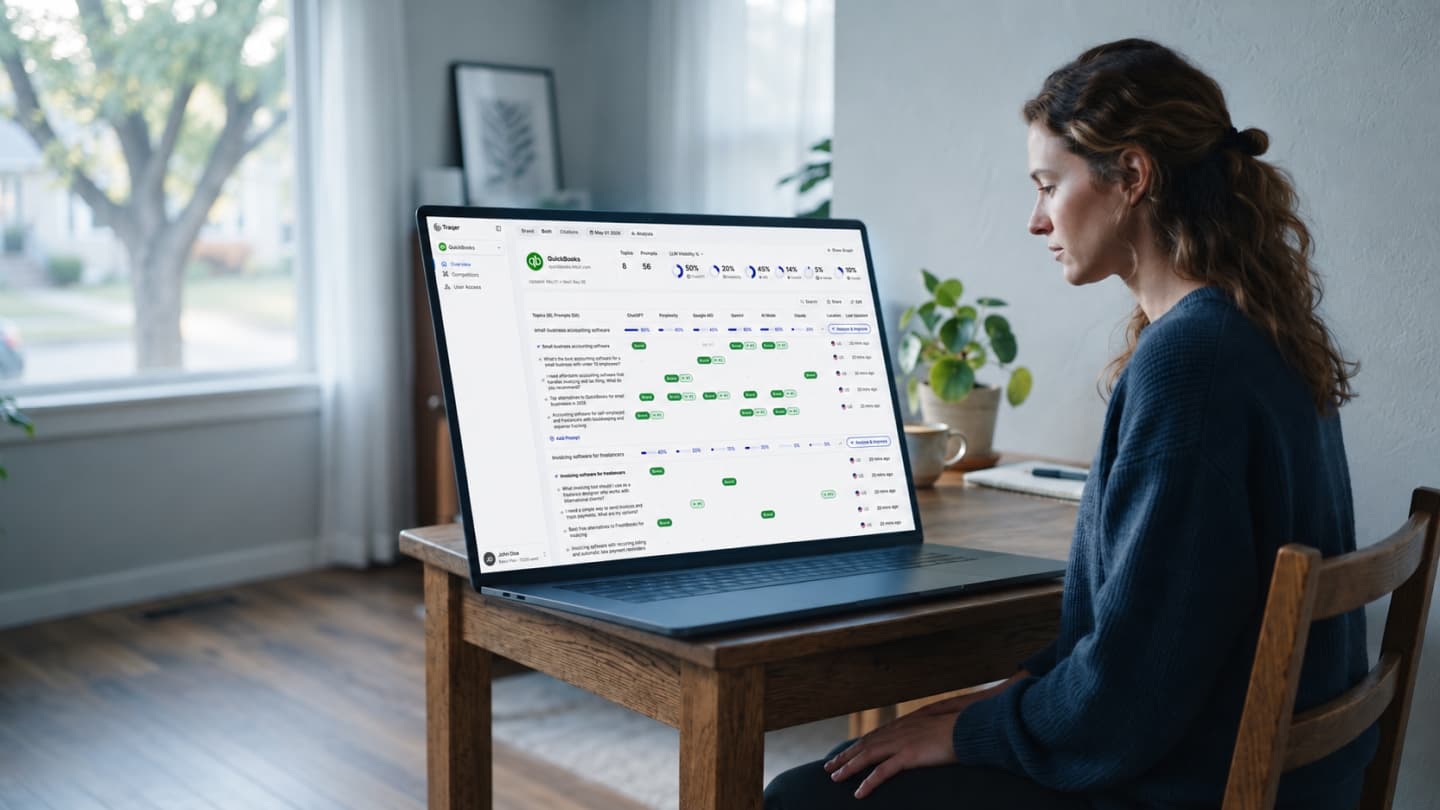
Lots of guides to affordable AI search visibility tools for freelancers rank a handful of tools by sticker price and tell you the cheapest one wins. That is the wrong lens for a solo operator, and it usually leads you to a tool that’s cheap on the invoice but useless in practice.
Affordability, for a freelancer or independent consultant, is more about finding the lowest-priced tool that gets you meaningful, reportable numbers on AI visibility for your clients. And it’s about not getting locked into a long-term contract when your client list might change month-to-month.
We built Traqer specifically for agencies and freelancers because we felt two things directly:
Plans on the heavy-hitting platforms (like Profound or Peec) add up to unaffordable, and are priced for teams who are tracking one brand with a big budget
Many of the cheaper tools don’t track AI visibility in a way that makes sense; their methodology was flawed and we couldn’t report accurate results to clients
In this guide we walk through why AI visibility is harder to measure than it looks, what actually matters when you’re choosing a tool as a one-person business, and how the main affordable options compare.
Why AI visibility is harder to measure than it looks
Traditional SEO is measurable in a way AI search is not. You pick a keyword, you rank or you don’t, and a rank tracker tells you where you’re at today and where you were last month. Give or take, everyone searching that keyword sees roughly the same page of results.
AI search breaks all three of those assumptions, and it matters for how you spend money on a tool.
The first problem is you don’t know the prompts. People don’t type short, repeatable keywords into ChatGPT. They have longer conversations, and the model incorporates a chunk of context you’ll never see, from the person’s company size, to the tools they already use, to the specific problem they’re trying to solve. We call this phenomenon invisible prompts. You cannot reproduce a real user’s prompt, which is one reason you cannot track it the way you’d track a keyword.
The second problem is that the same prompt doesn’t return the same answer twice. LLMs generate responses probabilistically, so asking the same question repeatedly surfaces different brands, in a different order, from one run to the next. There’s no fixed ranking to read. Any tool that reports a company’s “rank position in AI” is actually selling a number that changes every time the model gets asked.
But there’s still a stable signal underneath all that noise.
While the exact list shifts run to run, the pool of brands a model draws on for a given topic holds much steadier. That’s the thing worth measuring. What matters is how often your client appears across many variations of the same question, rather than whether it happened to appear in a single run.
That is why Traqer monitors visibility at the topic level rather than the prompt level. A topic is a cluster of related prompts that all point at the same buying-intent question from different angles. You measure the percentage of prompts within that topic where your brand appears, broken out per LLM.
The more consistently you show up across a topic, the more likely a real user is to see you, however they happen to phrase their question. We go deeper on this in our piece on AI search visibility metrics.
The affordable AI visibility tools for freelancers and consultants
We’ve listed a few of the most affordable AI visibility tools below, starting with our own tool Traqer.
Traqer
We built Traqer because we run a content marketing agency (Grow and Convert) and needed to track AI visibility for our own brand and dozens of clients without the cost getting out of hand.
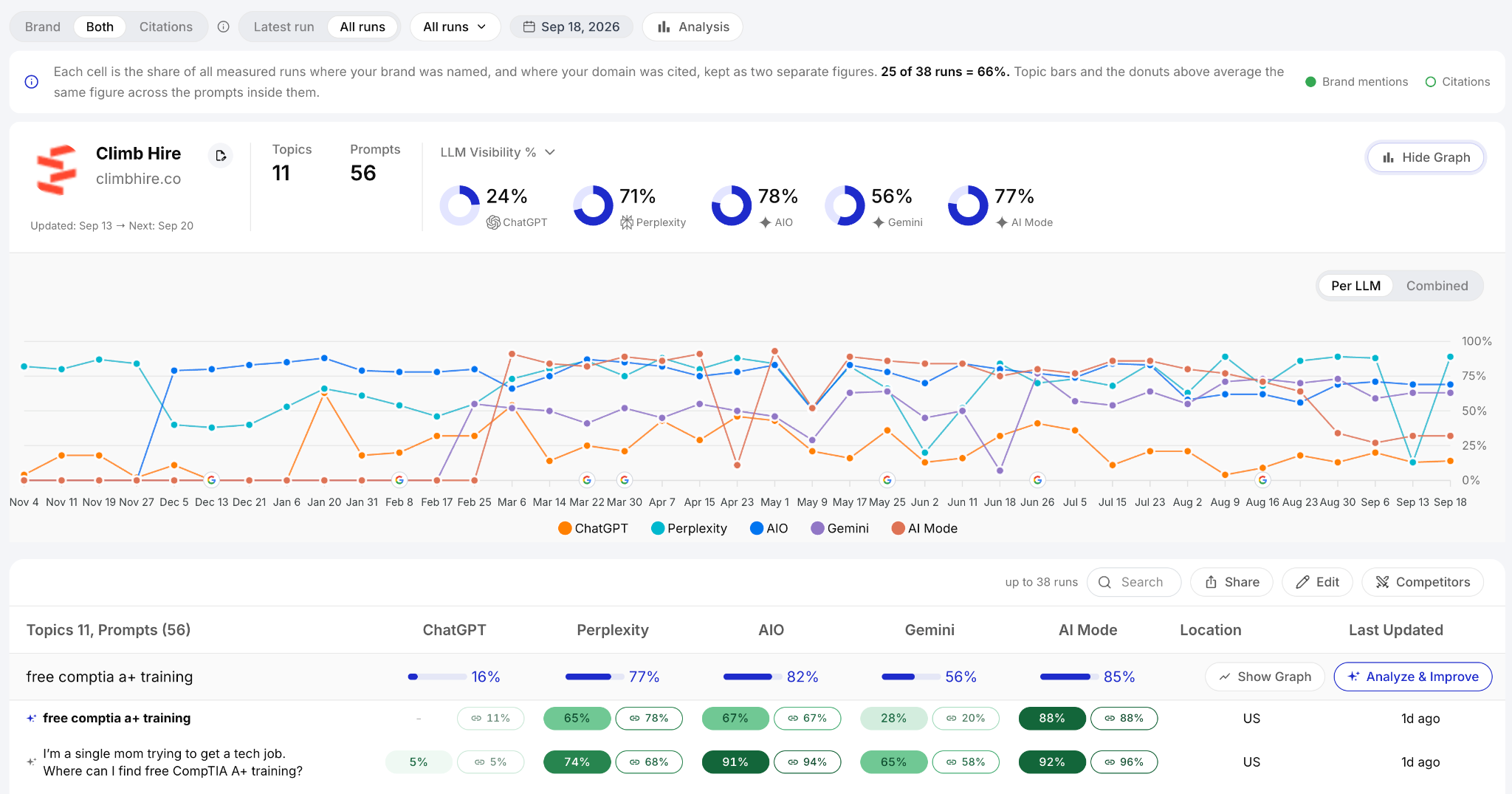
Traqer covers ChatGPT, Claude, Perplexity, Gemini, AI Overviews, and AI Mode.
It starts at $25 a month for 10 topics and 50 prompts, and the pricing scales with prompt volume rather than with additional brands or users. There's no per-brand charge and no per-seat charge, so tracking your own site alongside a client's site does not change what you pay unless you need more prompts. For a freelancer juggling a few different brands at once, this is pretty useful.
At the brand level, Traqer gives you three views:
LLM Visibility % is the share of tracked prompts where you appear, shown per LLM rather than blended into one number.
LLM Visibility Count is the raw number of prompts where you appear, which only goes up when you actually gain ground and can't be gamed by trimming weaker prompts.
Topic Visibility counts how many topics your client has some or strong visibility in.
The last two are the metrics that tend to get reported most often to clients, because they only move in one direction when your work is paying off.
Traqer also separates brand mentions from citations with a toggle on every page, and each topic has an Analyze and Improve view showing which brands the LLMs name most, which domains and pages they cite, and where your gaps are. Data refreshes weekly, and you can compare any two dates side-by-side, so you can show growth over time and point to the work you've done.
At the prompt level, you can switch from the latest run to all runs and see the full history for that prompt, including how often you were mentioned across every run and a run-by-run pattern of which runs actually included you.
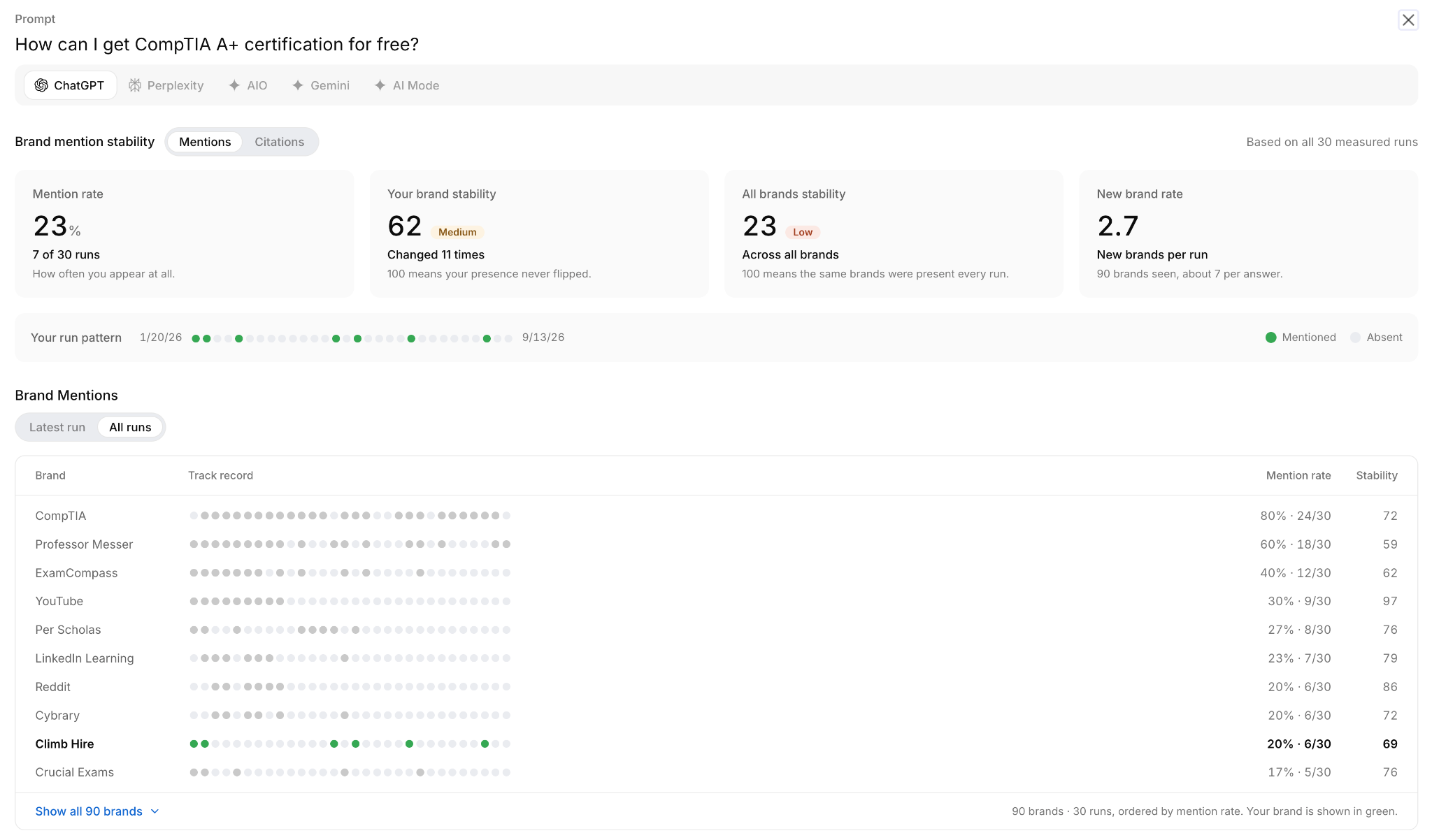
Because the same prompt rarely answers the same way twice, that full history is what separates a consistent appearance from a one-off. A prompt can read as low visibility because you were mentioned once weeks ago and never since, which is a different story from steady coverage.
In summary, Traqer offers:
Pricing designed for freelancers and agencies (starting at $25), with no per-brand or per-seat charge, so you can track your own site alongside a client or two without the bill rising
Accurate topic-based tracking that measures how often you appear across many phrasings of a question, rather than an unstable single-prompt rank
Full run history for every prompt, so you can see how often you appear across all runs and tell a steady presence from a one-off result rather than trusting a single check
Brand mentions reported separately from citations, so you can report on whether your clients are being recommended or merely referenced
Reporting data you can put in front of a client, with per-LLM breakdowns and date comparisons that show visibility moving over time
It fits freelancers and consultants who want an affordable LLM visibility measurement tool that they can rely on. You can start tracking your visibility at traqer.ai.
Otterly
Otterly is one of the more established tools at the accessible end of the market, with entry-level pricing aimed at light AI visibility monitoring. The setup is straightforward, the interface is clean, and the core job of monitoring brand mentions across AI responses works as described. It is a reasonable starting point if your needs are simple and you are tracking a single brand.
The consideration for a freelancer is the underlying model. Otterly is built around single-prompt tracking, and because LLM output is unstable run to run, results from any one prompt carry too much natural noise to lean on. Without a topic-level structure that aggregates multiple phrasings of the same question, it is harder to separate a real trend from randomness. Otterly has been continually developing its product, so it is worth checking where it stands when you evaluate it.
SE Ranking
SE Ranking has added AI visibility tracking to its broader SEO platform, covering brand mentions and citations across ChatGPT, Google AI Overviews, AI Mode, and Gemini, with competitor comparison and source data. If you already pay for SE Ranking for traditional SEO work, the AI tracking arriving inside a tool you use is convenient, and the combined subscription will be cost-efficient for a freelancer.
The trade-off is depth. As a module inside a general-purpose suite, the AI tracking tends to run on periodic prompt checks and report a visibility score, which is useful for a high-level read but thinner than a tool whose whole job is the measurement problem.
It tracks a fixed set of prompts and reports the share where you appear, rather than clustering many phrasings of the same question into a topic and measuring visibility at that level. For a freelancer, topic-level aggregation is the part that smooths out single-prompt noise and shows how reliably you surface on a buying question, however it is worded. If AI search is a small part of what you do, the convenience of one login is worth considering. If it is becoming central to how your clients get found, the shallower AI module starts to show its limits.
What about Scrunch, Peec, and Profound for freelancers?
Scrunch, Peec, and Profound come up in almost every AI visibility tool comparison post. But they’re not ideally suited to freelancers or small agencies tracking multiple clients.
Scrunch is a monitoring and citations platform primarily aimed at enterprise marketing teams and agencies. The tracking side is capable. It covers brand presence and competitive presence across models, sentiment over time, and a detailed citation layer that surfaces the domains and URLs cited most often, breaks citations down by owner, and tracks which sources are gaining or losing ground. If citation analysis is central to how you work, there is a lot here.
Two things make Scrunch a poor match for a freelancer. It’s built and priced for scale, with the entry tier sitting well above what most solo operators will spend, so verify the current number on their pricing page before you rule it in or out. And the product is organized around citations as the lever, to the point of offering partner integrations that turn citation gaps into placements. That rests on the premise that securing citations leads to being recommended. In our experience the two do not move together so reliably. Brand mentions are the commercial signal, citations are a supporting input and an outreach map, and we wouldn’t treat one as a dependable route to the other.
Peec is a VC-backed platform that launched in early 2025 and, like Traqer, uses real web scraping rather than APIs to fetch LLM responses. Its Starter plan is around $95 a month for 50 prompts across three engines, with additional engines available as paid add-ons, and Claude reserved for its Enterprise tier.
Profound is the established enterprise option, well funded and clearly built for large in-house marketing teams. Its pricing starts around $99 a month for ChatGPT-only tracking on annual billing and climbs quickly once you add engines, with enterprise contracts running well above that.
Both are very credible products with good reputations. But neither is built for a freelancer. The way pricing climbs on both is designed for a team tracking one brand with a marketing budget behind it, not a solo consultant tracking their own site and a client or two.
We compare the mid-market and agency options in more detail in our roundup of affordable AI search visibility solutions and our guide to the best LLM SEO tools for agencies.
What an AI visibility tracker can and cannot do for you
A tracker tells you whether the work is landing, but that’s it. The two things that actually move your visibility are owned content (that ranks in traditional search) and brand mentions on the pages the models already cite, and both take weeks to show up. If you want to go deeper on the strategy behind improving AI search visibility rather than just the tracking, Grow and Convert’s articles about Topic-Based GEO and Prioritized GEO explain the thinking behind how Traqer was built.
What a tracking tool gets you is the ability to see whether your content is performing, and to show a client the same thing in a language they understand and trust.
If you want a tool built around the way AI search works, priced for a freelancer carrying a few brands rather than a team with one, Traqer fits that use. Topic-based tracking, per-LLM breakdowns, real web data, and brand mentions kept separate from citations, from $25 a month with no per-brand or per-seat charge. If you already run your SEO inside a broader suite and AI search is a small part of what you do, SE Ranking's AI module keeps everything under one login. If you’re serving enterprise clients who need citation analysis at scale and can absorb the cost, Scrunch, Peec, and Profound are built for that tier.
Try Traqer for free today