
Google AI Mode is a conversational search experience on Google's normal SERP that's built on Gemini. But unlike Gemini, which answers mostly from what the model itself has learned, AI Mode builds its answer from Google's live search index (as Google's own documentation describes). Rather than returning links, it takes a question, breaks it into several related searches that run in parallel, and synthesizes the results into one written answer, with follow-up questions handled in the same session.
That distinction has real consequences for visibility. Because it pulls from pages already ranking on Google, brands surface in AI Mode (and AI Overviews) far more often than in Gemini, ChatGPT, or Perplexity, as our data across clients shows. For a brand, the bit that matters is whether that answer names you or links to you when someone asks about products in your category.
Even so, AI Mode has no fixed ranking to check. It pulls a different set of sources from one run to the next, and it tailors answers to the logged-in user in ways no outside tool can see. Google currently gives you no report on whether your brand appears inside an AI Mode answer. Your analytics might show a few referral clicks, but they won't tell you how often AI Mode is recommending you in its generated text.
We ran into this while tracking LLMs for our clients at Grow and Convert, which is why we built Traqer, an AI visibility tool that covers AI Mode, AI Overviews, Gemini, ChatGPT, Claude, and Perplexity. This post covers what an AI Mode tracker can and can't measure, why AI Mode is harder to track than Google rankings, which metric to track instead, how to set tracking up, and what to do with the data.
Important: brand mentions and citations are different signals
Before tracking anything, separate two things AI Mode can do with your brand, because lots of tools collapse them into a single number. A brand mention is AI Mode naming you in the answer as one of the options worth considering, for example “QuickBooks is one option for small business accounting teams.” That’s a recommendation the reader sees, and it's a signal that’s most likely to drive a lead.
A citation is your URL appearing as one of the sources behind the answer. It tells you that your content was good enough for AI Mode to build on, but it doesn't mean the answer told the reader to consider you. Your page can be cited while a competitor is the brand being recommended. Both are worth measuring, but they indicate different things and shouldn’t be conflated or combined in your reporting.
(For the approach that works across every platform, see our guide on how to track brand mentions in AI search.)
Why AI Mode is harder to track than Google rankings
SEO rank tracking works because Google's classic results are broadly stable. One keyword returns roughly the same ten results, and you can check your position over time. AI Mode offers none of that.
There’s no fixed ranking to track. AI Mode generates answers probabilistically, so it varies by design. A large study of AI recommendations ran nearly 3,000 prompts across different LLMs and found under a 1-in-100 chance of getting the same list of brands twice from the same prompt. In short: there is no stable “position” to record over time.
Query fan-out changes the sources every run. By Google's own account, AI Mode doesn't answer your query directly. It breaks the query into a set of related sub-queries, runs them at the same time, and assembles the answer from the sources that come back across all of them.
A search for “best transportation management software for bulk haulers” might fan out into separate searches for related features, small-fleet options, and recent reviews, each surfacing its own pages. Because that fan of sub-queries isn't fixed, the same question can pull a different set of cited sources from one run to the next, even when nothing about your content has changed.
AI Mode personalizes to the user. AI Mode is conversational and tied to a Google account, so it factors in the user's location, search history, and prior context when it answers. A tracking tool running the same question from a clean session isn't seeing what a specific logged-in buyer sees. This is the problem of invisible prompts, and it applies more to AI Mode than to AI Overviews, which respond to shorter keyword-style searches with less personal context behind them.
AI Mode is not the same surface as AI Overviews. Both are Google, both are search-based, and both use query fan-out, but they sit in different places and can cite different sources for the same query. A single blended “Google” number in your tracking hides that, so it’s worth monitoring them separately. (The same goes for every engine. We report per LLM rather than combining, because not all LLMs are the same: the platforms behave very differently.)
API data isn't what users see. Many LLM tracking tools query models through their APIs because it's cheaper and easier. API responses run without the interface tuning that shapes a real answer, so a source cited through an API may not be cited in the product a customer actually uses. This was the main reason we rebuilt Traqer around responses captured from real logged-out browser sessions.
Track visibility at the topic level, not the single prompt
If a single prompt result is unreliable, the answer isn't to track single prompts more carefully. The better approach is to stop reading them one at a time and measure how often you appear across many related prompts.
Any single run is close to random, but how often a brand appears across dozens of runs of similar prompts is stable enough to act on. In Traqer, the topic is the top of that structure. A topic, for example “content marketing agency for SaaS companies” sits above a set of prompts that approach the same buying question from different angles. Your visibility for that topic is the share of its prompts where AI Mode names or cites you, reported for AI Mode on its own rather than blended with the other engines.
Below is a screenshot of a company tracking the topic “booking management software” and you can see their AI Mode visibility is at 76%. This means that across the full set of prompts Traqer runs for that topic in AI Mode, the company appears in 76% of them. Put another way, in roughly three out of every four ways a buyer might phrase the question, AI Mode's answer names or cites them.
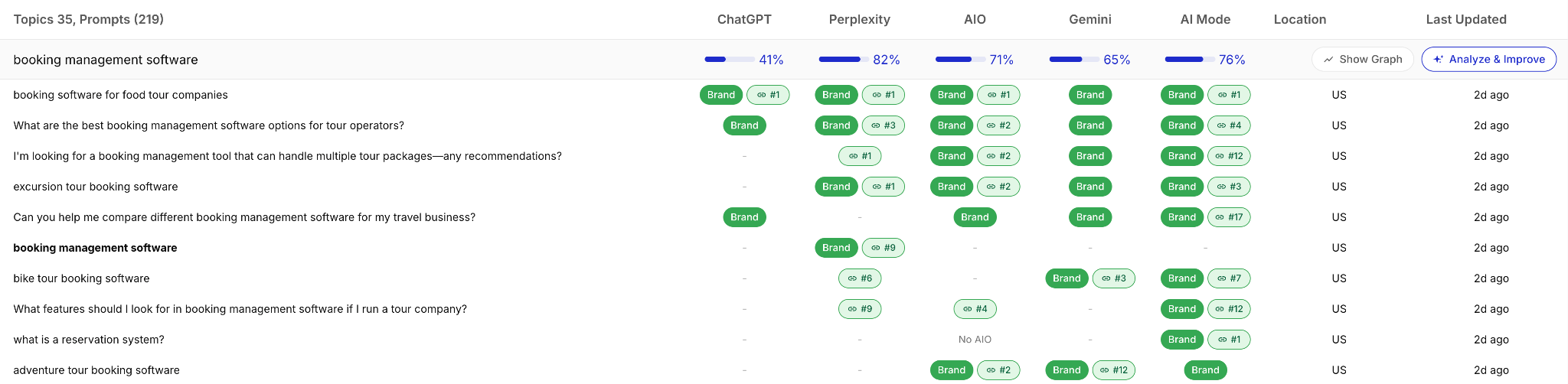
Reporting this way also avoids a metric that games itself. A single visibility percentage improves the moment you stop tracking the prompts you don't appear on, without anything real changing. A visibility count at the topic level only rises when you start appearing on more prompts, which is the thing you actually care about.
How to set up Google AI Mode tracking
Setting up AI mode tracking involves a few important decisions up front:
Choose product-centric topics, rather than relying on a tool's default prompts. AI Mode only names brands when there's buying intent in the question. Ask it what a category is (e.g., what is customer relationship management?) and you’ll usually get an explainer with no recommendation; but ask it for the best product/service for a specific situation and brands will appear.
Build your topic list from the queries your buyers use when they're comparing options; the part of the funnel where AI recommendations actually happen. Anyone already running Pain Point SEO will be familiar with this list. Traqer suggests topics and scores each prompt by how likely it is to trigger a recommendation, so the informational ones are easy to weed out. But you should always add your own based on your own expert knowledge of your customers.
Write a spread of prompts for each topic. Query fan-out and personalization both mean a single phrasing captures almost nothing. Give each topic several prompts that ask the same buying question different ways, and include a short keyword-style version, since plenty of people still type a few words into Google rather than a full sentence. Traqer assembles this set when you add a topic.
Monitor AI Mode as its own engine. Track AI Mode beside the other platforms your buyers use, and hold it apart from AI Overviews and Gemini instead of folding everything into one Google figure. These tools draw from different places and frequently don’t match.
Decide on your metric up front. As we mentioned earlier, a brand mention and a citation should be considered separate outcomes for your content strategy, and you should report them separately.
Read it as a trend, not a snapshot. A single week's figure says very little without context. Traqer refreshes weekly and sets two dates against each other, which is how a topic climbing or slipping in AI Mode becomes visible and meaningful over a longer reporting period.
It’s worth remembering that no external tool can see a real user’s personalized, logged-in session. What Traqer records is a consistent logged-out baseline, which is the best basis for watching a number move over time. We stop well short of claiming to mirror any single buyer’s exact result; no products can do this.
How AI Mode tracking data informs your content strategy
Like AI Overviews, AI Mode summarizes Google's search index rather than answering from training data alone. Across the clients we track, AI Mode and AI Overviews consistently show the highest brand visibility of any platform, because the brands we've ranked on Google for bottom-of-funnel keywords are the ones AI Mode tends to pull from when it fans a query out. We saw this with our client Toro TMS, a software for trucking and bulk hauling companies. Once we’d produced pain point-focused content that ranked on Google for their buyer-ready keywords, their visibility in the Google AI surfaces followed.
That points to two levers, both drawn from our Prioritized GEO framework.
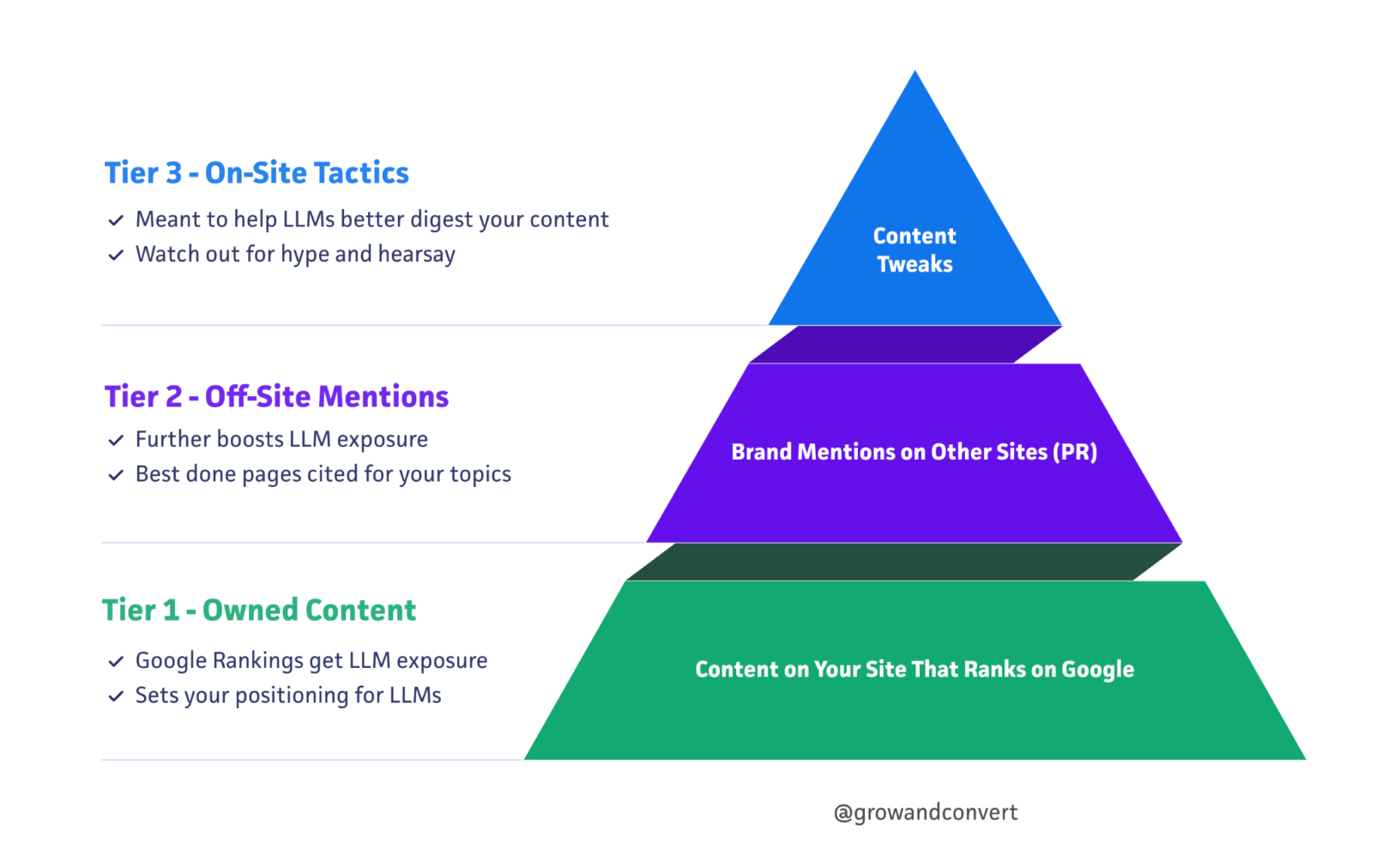
The first is owned content that ranks for the traditional keywords behind your topic, since AI Mode is reading Google's results to build its answer.
The second is getting mentioned on the pages AI Mode already cites for those topics, which Traqer surfaces per topic so you can see the outreach targets. On-site tactics like llms.txt files and FAQ schema haven’t moved AI Mode visibility in our testing, so they aren't where we'd start.
Neither lever guarantees a result. A strong Google ranking raises your odds of being pulled into an AI Mode answer, but it doesn't force it, and AI Mode's variability means visibility still moves around.
You can separate real progress from noise by tracking AI Mode properly, by topic and over time, which is what we built Traqer to do. You can try it on your own brand and see your visibility across AI Mode and the other engines for free.